
Making peace with the past, and its scars
In the process of
writing last week’s post about transformation I started thinking about my
phoenix tattoo, which got me thinking about regret and acceptance.
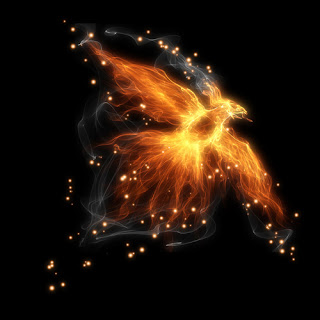
The phoenix is,
of course, a potent symbol of transformation. It’s the mythical bird that rises
from the ashes after adversity. The caterpillar emerging from its cocoon into a
beautiful butterfly. You get the idea.
I was certainly making a statement when I chose to get a phoenix tattooed on my upper back at the age of 22. I was also ahead of my time, as Ben Affleck has just done the very same (although his is more colourful and impressive).
I was certainly making a statement when I chose to get a phoenix tattooed on my upper back at the age of 22. I was also ahead of my time, as Ben Affleck has just done the very same (although his is more colourful and impressive).
To give you some background, at the time I got inked, I had come through the other
side of a battle with depression and a redundancy. I wanted to carry a mark
that would symbolise my resilience and inner strength. I hoped it would give me
something to draw on in challenging times. I believed, in the naïve way that
only a 22-year-old could, that I was through my biggest personal crisis. I did
not then understand that life is a series of challenges and strength building,
and that we are reborn again and again and again (unless, of course, we choose
to stay stuck).
Instead of being
a badge of honour, the tattoo became a source of regret. It didn’t remind me of
my transformation, it only reminded me of the misery that had permeated that
chapter of my life. I felt disappointed that I had not grown enough to become the person I had believed I could be on day in a dingy Auckland tattoo studio. Plus, it was kinda ugly.
So, in my early
30s I decided to have it removed. Unfortunately the laser treatment process was
excruciating (vastly more painful that the tattooing process), and was
predicted to become more so as treatment progressed. It was also costly. So
after five treatments I decided to make peace with the now slightly faded bird, and quit treatment.
 |
| My tattoo removal story in Women's Health magazine |
What I’d been
trying to do was the equivalent of what people do on Instagram every day – edit
out the ugly side and present only the elements of myself that I wanted to be
seen. I knew that getting rid of the tattoo would not alter the course of my
history, but at least it would mean I wouldn’t have to keep reflecting on it –
because every time someone saw the tattoo I had had to explain (in the vaguest
of terms) that I had been through “a rough period”. In doing so I was invoking
the heavy energy around that period once again. I felt a whiff of the despair and, just like a dementor in Harry Potter, its darkness loomed large. I didn’t want to be dragged down by that chapter any
longer. I wanted to put that behind me once and for all.
So very idealistic.
So very idealistic.
The past is ugly.
It has shadows and it leaves scars. It cannot be erased – even with the heat of a laser. The challenge for me has
been in finding a middle ground between acceptance and regret. More than a
tattoo could, it was in writing about my battle with depression that I finally
made peace with the parts of myself from which I had bled so profusely (read
that post here). I now neither embrace nor recoil from reminders of my past struggles. I have taken the lessons and am doing my best to gently move on. I have regrets, but I no longer ruminate on them.
We are all better off for what we’ve been through, good and bad. That’s the unsightly truth.
We are all better off for what we’ve been through, good and bad. That’s the unsightly truth.
On necessary heartbreak
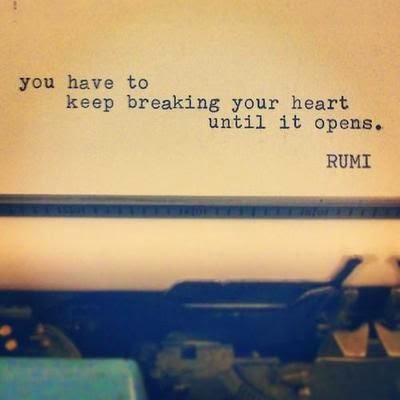
 "You have to keep breaking your heart until it
opens."
I’ve
never met a Rumi line I didn’t love, and this sentence is one of my absolute
favourites. It reminds me of a quote I read last year by the peerless Cheryl
Strayed. Someone had written a letter to her ‘Dear Sugar’ advice column (BTW if
you’re not familiar with the Dear Sugar series, you are truly missing out)
asking what advice she would give to her twentysomething self.
Her characteristically eloquent response included reference to her decision to divorce her husband in her mid-twenties. She had still loved him, but even though she could not say why, she knew she didn’t belong in the relationship anymore. Cheryl closed with this quote, which I have loved ever since and never forgotten: “Be brave enough to break your own heart.”
Her characteristically eloquent response included reference to her decision to divorce her husband in her mid-twenties. She had still loved him, but even though she could not say why, she knew she didn’t belong in the relationship anymore. Cheryl closed with this quote, which I have loved ever since and never forgotten: “Be brave enough to break your own heart.”
When I first read this, it leaped off the page and dug its steely fingers around my own silently shattering heart. You know that feeling, I know you do. Something resonates with you so strongly you’re sure it was written just for you, just for that moment. It is the truest thing of all the true things that have ever been before. At the time I was in the process of completely uprooting my life in New Zealand and moving to Australia for no good reason other than the fact that I could not stay. And no matter how many times people asked me why I was leaving, I could not produce a better answer than “I need a change” – as if this were sufficient to justify the wrench of leaving all the people I loved. If you’re going to leave behind the people who define you, bolster you and imbue your life with so much meaning, you’d want to have a very good reason. I didn’t. Staying meant stagnation, but leaving meant losing so much. I knew ultimately that I would gain in the long run, but in that moment, surrounded by boxes, Customs forms and piles of the objects that had amounted to my life in Auckland, I could only see the losses.
You must be strong
enough to break your own heart. Friends, I held these words to my chest
and I repeated them at 2am when fear and despair kept me from sleep. I uttered
them when I found myself shaking in the toilets at work and in the evenings
when I ran out of tissues to collect my tears. These words reminded me that I
had to do the thing I did not want to do – even though it made no sense - and proffered the dimmest promise of finding hope on the other side.
We
do not grow when we stay stuck, we grow when we take risks and follow our
instincts, even when common sense and peer pressure do not support us in those
actions. I broke my own heart and I found – as I had suspected it would – that
the being strong made me even stronger. It was the right thing and the best
thing to do, and it was worth all the tears and all the despair.
My
affection for Cheryl’s prose is matched only by my adoration of Rumi, and I
firmly believe there is Rumi line for every occasion. On the subject of
necessary heartbreak, he offers this: “The
wound is the place where the light enters.”
And
where light enters, growth happens.
(That
last sentence is mine, but you can use it.)
Have
you ever broken your own heart? I’d like to give you a high-five. And a hug. Because
that is an act of bravado, not to mention self-love. Email me your story here.