
Transformation is hard. But staying miserable is harder
 I’ve always been
fascinated by the idea of transformation. When I was a kid my favourite TV show
was Jem and the Holograms. I loved that mousy Jerrica Benton had the ability to
transform into a glamorous and adored popstar just by touching her star-shaped
earrings. You can see how the idea of escaping a mediocre life
and becoming extraordinary held such appeal to a young girl who was painfully
shy and socially awkward. Come to think of it, the Jem narrative is probably the
little girl’s equivalent of Clark Kent transforming into Superman. But with fun
music and no burden of civic responsibility. And a lot of pink, which is still
my favourite colour.
At some point in
my childhood, I realised that most people are programmed to follow the same template for who you become. Something like this: get a
job in an office, climb up the ranks, marry, have
two kids, get two cats that ignore you (I swear I’ll never understand why people bother
with cats!), move to a retirement home, forget everything, then die. The idea
that you could choose your own direction and change it at any point was foreign to me. I did
not yet understand how much power we have to shape the course of our lives, and
how restrictive the supposedly safe path we are taught to follow really is.

Christiaan is open about the fact that there were some pretty dark periods while he was in quarantine, but he says at no point in his lowest moments did he wish he had spent more time in the office or at work meetings. At the most challenging time in his life he had woken up to the fact that his career and substantial pay packet – the two things we’re all taught to chase, covet and hold dear – meant nothing. What mattered was how he had spent his 27 years on the planet so far – and that picture just wasn’t satisfying enough. When he was released from hospital he realised he could not go back to his corporate life – he had to keep living a life of creative expression. I’m paraphrasing here, but what he was saying to us was that he could no longer ignore the voice that had been begging him to live fully on his own path instead of dying partially on the conventional path.
If there is
something your soul is longing to do, why aren’t you doing that? Maybe you
yearn to write a book. Maybe you dream of fostering kids. Maybe you want to be
an alpaca farmer (that would be so great – alpacas are really cute!).
 Maybe the idea of
transformation scares you. I get that. When you go in a direction that doesn’t
fit the template, you have no certainty. But here’s the thing: there are no
guarantees on the ‘safe’ path either. You could lose your job. Your spouse
could die. Your kid could end up a drug addict. You could get tuberculosis. Your
life could be thrown into turmoil at any moment. In such a volatile world,
isn’t it better to choose a path that makes you happy?
If there is a
voice in you telling you that something needs to change, maybe it’s time to listen
to it. Transformation is not easy. It creates a rupture in the fabric of your
life, and it can cause friction in your most intimate relationships. You might
fail. You might end up poor. You might lose your reputation. But there’s one
thing harder than transformation: not changing. Not changing leads to regret.
And, just like a quarantine hospital ward, regret is a miserable place to live.
You don’t have to
own a pair of pink star earrings to transform your life, you just have to
listen to your heart. You already know what you need to do.
There are a thousand reasons to be cynical. Don't. Just believe

Sometimes I feel like
a bit of a hypocrite when I’m doing angel card readings. So often I relay angel
messages to clients about having faith that everything will work out, and
trusting in the Universe’s plan. Then I finish the reading, go home or log out
of Skype, and fall to pieces because cashflow is slow or a guy I like hasn’t
texted me back. Really, I could do with taking on the guidance I’m dispensing
myself – there are often messages in there for me too. As a very wise friend
once told me, we are here to teach what we need to learn.
Keeping the faith is
a recurring theme in my readings and, consequently, in this blog. In fact it
was the subject of the very first post I wrote on this blog, in November 2014.
It’s an ongoing struggle.
Every day we are
asked to believe in things which we cannot see or that are not guaranteed – weather
predictions, job security, recovery from debilitating illness and relationship
longevity, to name a few. Sometimes we do this easily, other times our desire
for control and our obsession with timeframes get in the way.
My love life is where
this shows up most for me. I have been told again and again and again in my own
readings that I will not be single forever. I have been sent signs, been
delivered messages in dreams and even had a message from a deceased relative
(via a spirit medium) all reassuring me that I will meet someone wonderful, and
I will know him when I meet him. This should be all the reassurance I need. But
I lose faith all the time. I look at all the beautiful, outgoing women in
Sydney and I think, well, since I can’t compete with that, what else can I
offer that would be attractive to men? And with no answers springing to mind, my
descent in a negative thought spiral begins.
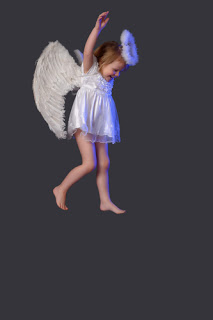 On Saturday night
when I was leaving the Taylor Swift concert, I was feeling miserable because I’d
seen a selfie in which I looked really old and haggard, and I felt that no-one
would ever want to date me at this late age and stage. For the past few months I had been feeling, for the first time in recent years, really fine with being single and quite relaxed to let things play out as they are supposed to. This storm of doubt had come out of nowhere. Then I got a
ridiculously obvious sign that I needed to snap out of it: I was jabbed in the
shoulder with some angel wings. Literally, not metaphorically. As I was walking
among the bustling crowd heading to the train station, a girl in an angel
costume (dressing up is not unusual at a Swifty concert) bumped into me, the
sharp corner of her wing pressing into my shoulder. It would be difficult to
overlook the symbolism. In fact I would have laughed out loud if I hadn’t been
feeling so sorry for myself. I probably should have laughed out loud. The
Universe has a sense of humour, after all, and I definitely deserved a prod for
being so self-pitying. And I could certainly do with lightening the fuck up.
What the Universe was
saying to me was exactly what the band Journey expressed lyrically in the 80s:
don’t stop believin’ (hold on to that feelin’…). We live in a cynical world,
and of course we have no proof of anything much, so it’s only natural that our
faith will falter from time to time. The challenge is to keep rising back to
that place where you believe in your dreams and in your luminous, tantalising
future again. Nothing is a given – that’s why they call it faith instead of
certainty. But believe we must. Without faith, without hope, the world is a
very bleak place.
I know that my
present situation is not my future. I have no evidence of this but I believe it
anyway. I know I will doubt it again and again, but I also believe I have the
resilience to return to all the things I believe in: transformation and beauty
and human kindness and miracles. And now I know that if I don’t, the Universe
will find a way to jab me in the shoulder and remind me.
PS I thought I should
expand this story by adding what happened the next day. I was prompted to draw
a card for myself from the Romance With The Angels deck. This is what I got:
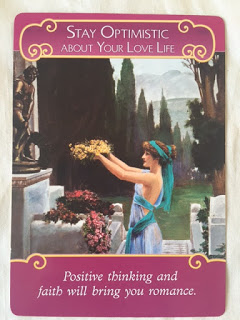
See what I mean about
that sense of humour?
‘You can’t sit with us.’ How squads and cliques show up in adulthood
Even
though I love the movie Mean Girls, it
does reveal some uncomfortable truths about the way we exclude others socially.
I also adore Taylor Swift, but her penchant for assembling beautiful people in
the form of a ‘squad’ takes me right back to the misery of teenage cliques.
There’s
an interesting study out of the US that shines a light on how being excluded
affects us on a deep level.
Researchers
at Ohio State University got 5000 participants to play a computer game in which
they were told to only ‘pass the ball’ to certain people. The players who were
excluded ended up with elevated blood pressure and stress hormones. The isolation
effect also triggered the part of their brains that processes pain – so being
excluded literally causes people pain.
I’m no
scientist, but I’d imagine those effects happen because our body recognises the
danger of being cast out of the pack. In evolutionary terms, our very survival
depended on being part of a tribe so we weren’t attacked by wild animals nor
left to fend for food on our own.
There
are emotional effects too, obviously. The researchers concluded that when we are ostracised, our self-esteem plummets (boo!). We lose a
sense of belonging, which, they noted, is extremely important to emotional
well-being.
I’ve
noticed the rise of the hashtags #squad and #squadgoals on social media, and
this trend bothers me because it smacks of elitism. That underlying exclusivity
really raises my hackles. What you are saying – and this is only my opinion – when
you describe a group of people as a ‘squad’ instead of simply ‘friends’ is, essentially
we’re a club – you do not belong. You can’t sit with us.

I
wrote recently about how a desire to fit in with the tribe sometimes shows up for
me (click here for that post). The fear
of being excluded is still real, well beyond my high school years. But perhaps that’s because I've always felt like an outsider.
A few
years ago I was absolutely devastated when I logged onto Facebook and saw
photos of my (now former) best friend’s baby shower – an event I had known
nothing about. All of our friends had been invited. To be fair, we had been drifting
apart for some time, and I am not particularly maternal so I’m not an ideal
baby shower guest. Still, the fact that everyone else in our circle had been
included, and I had not, was excruciating. The sting of being excluded by a
group of people I had cared about made me burn with shame.
I
would like to think that as I become more comfortable with being myself I will
become less concerned with how other people perceive me, and consequently how
they might treat me – i.e. by exclusion or acceptance. I’m aware that as a
highly sensitive, introverted person who works in the spiritual realm, I am
even less likely to fit into the mainstream now than I was in high school.
If no
one wants to sit with me, because they perceive themselves as better than me or
just because they don’t like me, I need to learn to be fine with that.
I’m
fairly confident that being excluded does not mean I’m in danger of being trampled
by a mammoth.
It's a good day to be thankful

Even though we
don’t do Thanksgiving here in Australia, I like to use the occasion to do a
kind of gratitude stocktake.
While most of us
have a vague understanding that gratitude can raise our mood and our life
satisfaction levels, in practice we’re not so good at actually maximising this superpower.
Most of us, it’s fair to say, have a tendency to ‘focus on the hole and not the
doughnut’, if you know what I mean.
It’s not just our emotional
health that benefits when we focus on gratitude, our physical health gets a
boost too. Research by Professor Paul Mills from the University of California
San Diego School of Medicine found that heart disease patients who kept a
gratitude journal had reduced their risk of ongoing heart issues after two
months. And similar studies have shown a reduction in stress hormones in those
who focus on gratitude.
Thanksgiving seems
like the opportune time to, you know, give thanks. Last night I sat down with a
pink pen and a pretty notepad (related: I am grateful for cute stationery) and
listed all the awesomnity in my life. It was fun and it helped me to see
clearly how much I have to celebrate. Afterwards, I felt like life had given me
a giant hug. My list included everything from my sister’s cute jokes to my long
legs to having a warm, safe place to live to being the most contended I’ve ever
been in my adult life.
When you write
something down, you amplify that message. It’s the equivalent of speaking to
the Universe through a loudspeaker. Writing down what you’re grateful for is
saying very clearly: “I am in love with my life, and I’m ready for more
blessings.”
I know that right
now you do not have everything you want. (Me neither.) But what you do have is
immensely valuable, and finding a way to take stock of that really helps you
appreciate that value at a deep level.
As Elizabeth
Gilbert says: “You were given life. It is
your duty (and also your entitlement as a human being) to find something
beautiful within it, no matter how slight.”
You are very, very
lucky, and very, very loved. Happy Thanksgiving xx
I used to hate birthdays. Now everything is different
 I celebrated my
birthday this week. I mean that literally – I really celebrated it. This is
significant for me because in past years I’ve greeted my birthday like a
smelly, irritating relative that comes to stay every year, whose presence I
endure with practised stoicism. The only celebration would happen the day
after, when I’d wake up awash with relief that it was all over for another
year.
My reasons for resenting
my birthday were partly due to the fact that it drew attention to me – and
as an introvert, this is excruciating. Seriously, I will vote for the next
politician who promises to ban the singing of Happy Birthday in workplaces. *shudder*
But at the heart of
my day-of-birth anxiety was the fact that they were a reminder that
another year had passed and I was not living the life I wanted to live.
There
was a sense that I was running out of time to be happy, or to achieve a life
that looked anywhere near as glossy as those of my peers. Every year my misery increased exponentially
as I was faced with the realisation that my life had not changed significantly
from how it looked at the last birthday.
This year, however,
felt different.
I’ve made some major internal changes during the year that have affected the way I see myself and my future.
I have a clearer sense of my life purpose and, most significantly, the value that I hold. I
can look back on my regrets without feeling burdened by them. Right now I’m in
the process of changing careers, so I don’t feel stuck or inadequate professionally any more.
I no longer fret about being single, nor interpret this as evidence that I am
flawed. It feels like I have enough time, and enough support from the Universe,
to grow to a point that I can emotionally handle, and flourish in, a relationship.

I have wonderful
friendships in which I have a sense of belonging and feel valued. Actually,
this is probably the most significant change of all when it comes to birthdays.
I can still remember the despair and humiliation of my 32nd birthday when only
two people showed up for drinks. As I write this post, I’m preparing to meet 18
friends for my birthday celebrations. This blows my mind – 18 people like me
enough to come and celebrate with me!
What all this amounts to is me having dropped my ideas of how my life should look – which is what was
causing my birthday angst in the past. Instead I’ve arrived at something very close
to acceptance of what is. I can recognise and celebrate the many blessings in my life and I don’t feel myself disappearing into the blistering chasm between the hand I imagined I would play, and
the hand I’ve been dealt. In addition, I know how much power I have to bring about change, so I’ve dropped my self-pity I used to hold.
Most crucially, I’ve
stopped comparing myself to other people on the regular. On this point my resolve gets
tested often (particularly on social media) but I’m better able to detach from comparisons, and jealousy. This
is not easy when you’ve grown up in New Zealand, a country where your
relationship status is prized above any personal attributes or achievements. But
it’s in my choices, not my circumstances, that I measure my worth now.
This is the first year
that I truly understand exactly how much I have to celebrate, and I have good reason
to believe that will expand and deepen as I age. In a culture
obsessed with time and deadlines, my anchoring principles are these: I am exactly where I am
supposed to be, and the best is yet to come.
I still hate that
fucking office birthday singalong though.