
Who’s to blame? Finding fault finds fault in us all
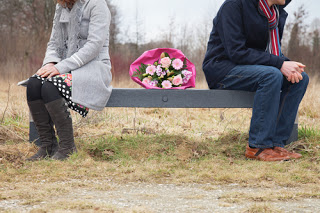 As we reeled
from the news of the Brad and Angelina split last week, I noticed an interesting pattern about
the way people processed this (arguably) major world event. A lot of people, I observed,
had a similar way of assessing this relationship breakdown – an instant urge to
look for someone to blame. I’m using the term ‘bad news’ loosely here since,
really, a celebrity split isn’t something that has an impact on us. But I’ve
realised this happens in situations close to home, too. When we hear about something
happening to others and we’re scared (whether we admit it or not) that this
could also happen to us, I’ve noticed that we have a tendency to label someone
as the good guy and someone else as the bad guy.
The reason I’m
talking about Brad and Angelina on this blog, which is generally a
celebrity-free zone, is because I’m
interested in the barriers we sometimes erect against compassion and empathy. Overlooking the fact that we’re patently entering the judgment zone when we comment on celebrities (which is not exactly healthy), I think the way we respond to events in Hollywood says
something about the way we respond to events in the real world.
 The concept of
blame first loomed large in my mind when a feminist blogger I follow on social media predicted that
Angelina would likely be cast as the villain by society, since unfortunately – and unfairly – it’s still seen as a woman’s job to hold a marriage and a
family together. To be honest I haven’t read enough about the split to know
whether this has played out, but the idea of choosing a villain is a
reasonable expectation. Remember when Brad and Jen split up? She was regarded as
a cold-hearted, career-hungry woman who had refused to give him the kids he
reportedly longed for – even though she had repeatedly said in interviews that she
*did* want kids. Yet Brad, who had clearly fallen in love with another woman –
which tends to spell disaster for a marriage, obvs – did not seem to be
lumbered with much, if any, responsibility for that relationship’s fracture.
Looking back on
when some of my friends separated from their partners, I’ve realised that although
I didn’t get involved, in my mind I definitely took sides (not, however, with any
gender bias). I apportioned blame to one party and sympathised with the other –
even though I’m well aware that relationship breakdowns are always a two-way
street. In some cases this was a show of support for the person I felt closest
to, but in other times it was because I was making a judgment about who had let
the other person down. Because I’m *such* a relationship expert, and other people’s relationships are totally my business (#sarcasm).
 I’m no
psychologist, but I feel like this is probably human nature. When we hear of
something upsetting, we look for ways to understand it. If we can frame it in a
familiar narrative – that of good vs evil – it’s easier for us to draw conclusions
about what happened, and ultimately feel better about it. If we can blame someone, we can reassure ourselves that it won’t happen
to us. Like this: My husband doesn’t have
any female friends so that won’t happen to us. Or: I never tell anyone my PIN so that won’t happen to me. And, chillingly:
I don’t walk alone at night so that won’t
happen to me.
My problem with
this kind of ‘good guy/bad guy’ narrative is not so much that it smacks of
self-righteousness, which is problematic in itself, but that it doesn’t allow space for compassion. If
we’ve decided Angelina ‘deserved’ a divorce, then we’ve overlooked her pain. Because whether you are the one who instigates a split or not, the end of a
romance is a bloody, bitter affair with waves of pain that knock you over long
after the event. In labelling people like they are simply characters in a story,
we erase their humanity.
Oh, I know what
you’re thinking – Brad and Angelina are celebrities, it’s not like they’re people
we know. But I have this nagging suspicion that the way we regard celebrities contains some truth about the way we
regard the people around us.
 I believe that in
any situation of conflict or disharmony, no one person is wholly to blame. Consider
this example. I have a friend who has been complaining for years about her
unhappy marriage. While I totally understand her need to vent, her tirade of
resentment is grating to listen to, and not only because it’s never-ending (and the fact that she has no family nor many close friends in Australia to talk to means I’m hearing it often). Her complaints focus only on the shortcomings of her partner, and wilfully overlooks
her own culpability in marrying someone whose behaviour had been disappointing
her long before they exchanged vows. By blaming him for her unhappiness, she
doesn’t have to take ownership of her responsibility for not only expecting him to be
someone other than who he was, but for continuing to accept a toxic home life
(i.e. not leaving him). Sometimes playing
the blame game is a way we hide. I’m not saying for a minute that she
deserves to be unhappy – no one does – and of course no one really has any idea
what actually goes on inside a relationship (which is another reason that passing
judgment is unwise). My point is that finding fault in other people can keep
us stuck.
I remember when I
was made redundant (the first time round, for those of you familiar with my,
ahem, “colourful” work history), an acquaintance remarked tersely that I really
should have seen it coming, since the company had been in financial
difficulties for a while. She was right… the writing was on the wall, and I
should have tried harder to look for alternative work. But does that mean I deserved
to lose my job and my final pay? Had I lost my right to feel
aggrieved about the unfairness of this situation? Was I the bad guy? As is
often true, this woman’s blame manoeuvre was more about her than it was about me.
(That won’t happen to me because I’d notice
if my company was going down the tubes and would quit.) Oh, the comfort
of superiority!*

From a spiritual
perspective, we’re here to be kind to each other. In an ideal world, this would
mean we’re able to feel compassion for, and offer support to, anyone going
through struggle such as divorce or job loss, regardless of who might have been
at fault. But the reality is that every
time we see someone suffering, we filter it through our own fears (we are
all programmed, after all, to protect ourselves from pain). And where fear goes, judgment usually
follows. I don’t really have any solutions for how to avoid falling into
this trap, but I have resolved to look out for the blame game when I notice
that pattern emerging in my little brain. This doesn’t mean I’d rush to comfort
a man who cheated on a friend, to give an extreme example, but hopefully I’ll
be less inclined to see situations as black and white. When we hold space for
people to be flawed, but ultimately deserving of love, we foster tolerance for
our own shortcomings and endorse our own worthiness, too.
Ideally, I’d like
to do better at listening and supporting without judgment. Something to aim
for, anyway.
*In the interests
of fairness, I should declare that I’ve totally done shit like this to other
people myself in the past. Ugh.
I'll sit with you when you're hurting. And I won't try to fix you

A couple of months ago there was a story bouncing around the internet
about a woman who’d created a series of greeting cards to send to someone going
through cancer. What was unique about Emily McDowell's cards was their raw honesty. Instead
of the trite, and frankly unhelpful, standard card messages, they said what
someone suffering a life-altering illness really needed to hear. Stuff like:
“Please let me be the first person to punch the next person who tells you
everything happens for a reason” and “I wish I could take away your pain. Or at
least, take away the people who compare it to the time their hampster died.”
But my personal favourite was this one: “I'm sorry I haven't been in touch. I
didn't know what to say.” I like this because it beautifully captures the helplessness
you feel when someone close to you is suffering, and you know there is nothing
you can say or do to ease their pain.
I was reminded of this recently when I was spending time with a friend
who is healing from a broken heart. Over the course of our conversation she ran
the gamut of emotions from rage to disappointment to shame to grief. I wanted
so badly to offer some advice or some truism that would help her find peace,
even if temporarily, but I had nothing. But that’s not what she needed from me,
anyway. It’s not up to me to fix the situation, my job is to be
there and listen. Empathy is not a verb, it’s a heart space.
Liz Gilbert wrote a beautiful and moving post a few months ago about the
despair she felt after another mass
shooting in the US, and how she attempted
to turn that sadness into hope on a micro scale: “When the world starts to feel
overwhelming in its sorrows, I always ask myself to look around me – to narrow
down my focus – and to notice somebody who is nearby me, who is suffering. I
can’t help the millions, but maybe I can help one. Life is hard; there is
always someone going through great pain. I tell myself: Go sit with that person
today for a while. Don’t try to solve their life, or answer for God [as to why
it has happened], or offer dismissive ‘reasons’, or try fix the whole world.
Just say, ‘I don’t know. But I will sit with you through this.’ Turn your
overflow of sorrow into love.”
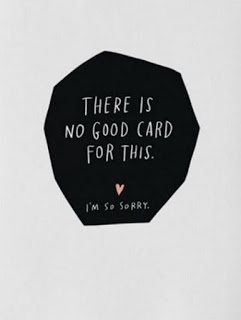 |
| One of Emily McDowell's beautiful cards. |
When you don’t know what to say or do, it’s tempting to either rush in
with solutions or platitudes, or to just back away completely. Don’t do that.
Lean in. Sit beside them and listen. That’s how you show love. That’s how you
say ‘I hate that you’re suffering and I can’t change that but I will bear
witness to your pain and hold your hand when you need me.’ What people need
when their world is broken is the warmth of human connection. That is the one thing you CAN do.