
Three things I learned in 2016

I could have written a post about how well I met (or didn’t,
as the case may be) the goals I set in early January, but I doubt my
yoga attendance record or attempts to address my tendency for lateness are of
much interest to anyone but me. What I’m writing about, instead, is what I’ve
learned this year. Because the truth is, the challenges are always more
interesting than the wins (right? right?).
Here goes.
Lesson
1: There is no one thing that makes everything perfect
 In theory, I already knew this. But I had to
experience it again to really understand it. Allow me to explain.
For years I’ve been banging on about how finding a
partner is not a magic formula for happiness and purpose, as it’s our sacred
responsibility to create these for ourselves. Even though I believed this devoutly,
there was still a part of me that believed love would somehow cause some deep
transformation that would result in me becoming a better, more confident, altogether
more complete person. So when I found myself in a relationship this year, for
the first time in many years, guess what happened? Nothing.
I mean, lots of stuff *did* happen – don’t get me
wrong, loving someone and being loved in return is wonderful and deeply
satisfying, and I am very happy – but it turns out I am still the same person as I was before I met
him. I’m still battling insecurities, afraid of my own inadequacy and
struggling to find my way in the world.
Without realising it, I had been looking for the one
thing that would make everything perfect. That’s a pretty familiar MO for me,
actually. Over the years such searches have included: cutting out gluten (it
will make me feel so much better!), taking overseas trips (it will help me find
myself!) and lastly, meeting someone who would sense in me something special,
something that I wanted so badly to be there… and was terrified was not.
A relationship, it turns out, does not so much fill
the gaps in yourself as much as expose new ones. This is as true about love as
it is about losing weight and getting a new job. Changing yourself has little
to do with changing your circumstances, and significantly more to do with
changing your thoughts and beliefs. And gratitude, always gratitude. There is no one thing, and there is no perfect. The best
work I’ve done in terms of my personal growth, this year and all years, had nothing
to do with any other human. And that’s as it should be.
Lesson
2: It’s OK if people don’t share my opinions or beliefs

I don’t know when or how this happened, but sometime during
the year I stopped giving a fuck about how people responded to what I do. I used
to avoid discussing One Grounded Angel, fearing the disapproval of others. This
did me an enormous disservice, and possibly also others who might have needed
some of the messages I was passing on. I suspect this reticence to be seen
diminished in direct proportion to my sureness about the value of the
information I’m passing on.
Of course, the more ‘visible’ I became, the more I
became exposed to criticism and negative opinions. My viewpoint on such matters
has always been this: what other people believe in is none of my business. I
won’t say it doesn’t upset me when people post messages telling me what I do is
bullshit but I would like to think I’m better at not taking that personally. This
is the mantra I intend to carry into 2017: I do not need the approval of people
who do not approve of me (that’s a life lesson from George Michael, by the
way).
Lesson
3: I have failed, but I am not a failure

I wrote about this at length in a June blog post (read
it here) so I’ll keep this to a brief summary. I had to change tack halfway
through the year, as my reiki practice rooms failed to attract enough clients
to be profitable. This stung. I felt personally inadequate, as if this lack of
success were an indictment on my own worthiness. It took a period of healing
and gradual acceptance for me to realise that this was not the case. This failure
does not make me a failure.
Everything has played out exactly as it was supposed
to. I don’t know why just yet, and maybe I never will, but I do know that
venture was not meant to be. And that must mean something better is coming.
2017, I’m ready.
The people you carry with you (and those you wish you could drop)

“Once in a while I return to the fold of people I
call my own.”
If ever you should find yourself adrift in a moment
you can’t put words to, I guarantee there is a Finn lyric that will do the job.
The beautifully simple piece of lyrical mastery
above, which has always stayed with me (as good songwriting should), is
from a 2006 Finn Brothers song called Won’t Give In. To me, this is
about the way our most treasured humans anchor us in time and space, shaping
our sense of identity and shoring up our sense of purpose. Last week I returned
to my homeland and spent a delicious week with family and friends, and I
observed, not for the first time, the effect that being in their presence had
on the rhythm of my heart. I felt lighter, I felt held. I remembered how much
the humans around me make me want to be a better human.
And then I remembered that some of the people who
make me a better human are not among my inner sanctum. Actually, some of the
people who’ve taught me the most are people I wish I’d never met.
Instagram, that dubious temple of modern
spirituality, is rife with quotes about the importance of spending time with
the ‘right’ people. Your vibe attracts your tribe! Surround yourself
with people who lift you up! Unfollow people in real life! These
snappy catchphrases are all helpful... but also unhelpful, I think, because
they implore you to judge people’s inherent worth (which rather undermines that
whole spirituality ethos, no?) What’s more, they don’t account for the fact that it’s not always possible to ditch the people who don’t behave in ways you want or expect (particularly
if you live with said people), and that many of those folks have probably
been brought into your life for a reason.
 Look, people are dicks sometimes. And that’s not a
bad thing. Because dickery (prob not a real word, but let’s go with it) can
teach us plenty. The bloke who pulled out from a side street in front of you
teaches you why being considerate on the roads is important, and why you need
to pay more attention while driving. The workmate who took credit for your
efforts teaches you why it’s important to acknowledge people’s achievements,
and that you need to make your boss more aware of your contribution. The date
who never called you back teaches you why it’s important to treat people fairly,
and what you’re *not* looking for in a partner. Yes, it would be ideal if these
people weren’t in your orbit – but that’s not how the Universe works. Mostly it
gives you the people you need, not the people you want (although, I am sure,
you have plenty of those in your life too).
Law of attraction pioneer Louise Hay believes that
the reason certain people annoy us is because they remind us of aspects of
ourselves we find uncomfortable. I have found this to be true in many cases.
About five years ago while reading You Can Heal Your Life, I had a
friend who constantly interrupted people, made bitchy comments behind people’s
backs and engaged in one-upmanship. You may wonder why I was friends with this
person. (I wonder that too, actually.) She was part of a group of girls I’d
been close with since university days and I felt a sense of loyalty to her.
Even so, I often found her behaviour infuriating, until (after reading Louise’s
insight) I realised how many times I did the same shitty things. Ouch. I, too, interrupted others. I definitely gossiped about my friends. And a tendency towards
competitiveness, driven by a fear of lack, is one of my least attractive
qualities. Even
though this girl is no longer my friend, I consider her one of my teachers
because she spotlighted areas I needed to address in order to become a better
person – and ultimately showed me how I didn’t want to live. I’m not
saying I don’t occasionally do these things still, but I’m getting pretty good at calling myself out when I do.
Think about the person who is really grinding your
gears at the moment, and ask yourself honestly whether you are replicating
their behaviour or attitude in some way, even at a low level. This won’t always prove
to be the case – and it certainly doesn’t excuse their bad behaviour – but if
you realise that they are mirroring you in some way, that may help diffuse your
anger slightly and help you look at the situation (and yourself) differently.
 You don’t have to put up with irritating, inconsiderate or just plain rude behaviour but
if it’s not possible for you to cut someone out of your life, reflecting on
what you can learn from the situation might make it more tolerable.
Above all else, what can be most helpful is
remembering that we are all dicks sometimes. I know I am. Happily, when human
contact becomes too exhausting, you can always return to the fold of people you
call your own. And you should, as often as you can.
On necessary heartbreak
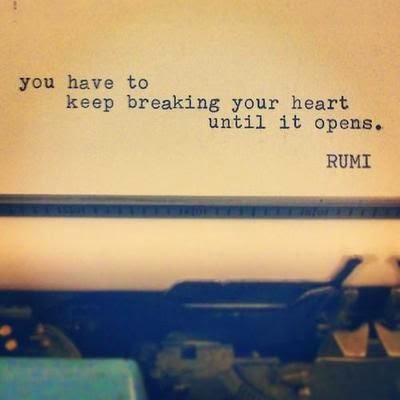
 "You have to keep breaking your heart until it
opens."
I’ve
never met a Rumi line I didn’t love, and this sentence is one of my absolute
favourites. It reminds me of a quote I read last year by the peerless Cheryl
Strayed. Someone had written a letter to her ‘Dear Sugar’ advice column (BTW if
you’re not familiar with the Dear Sugar series, you are truly missing out)
asking what advice she would give to her twentysomething self.
Her characteristically eloquent response included reference to her decision to divorce her husband in her mid-twenties. She had still loved him, but even though she could not say why, she knew she didn’t belong in the relationship anymore. Cheryl closed with this quote, which I have loved ever since and never forgotten: “Be brave enough to break your own heart.”
Her characteristically eloquent response included reference to her decision to divorce her husband in her mid-twenties. She had still loved him, but even though she could not say why, she knew she didn’t belong in the relationship anymore. Cheryl closed with this quote, which I have loved ever since and never forgotten: “Be brave enough to break your own heart.”
When I first read this, it leaped off the page and dug its steely fingers around my own silently shattering heart. You know that feeling, I know you do. Something resonates with you so strongly you’re sure it was written just for you, just for that moment. It is the truest thing of all the true things that have ever been before. At the time I was in the process of completely uprooting my life in New Zealand and moving to Australia for no good reason other than the fact that I could not stay. And no matter how many times people asked me why I was leaving, I could not produce a better answer than “I need a change” – as if this were sufficient to justify the wrench of leaving all the people I loved. If you’re going to leave behind the people who define you, bolster you and imbue your life with so much meaning, you’d want to have a very good reason. I didn’t. Staying meant stagnation, but leaving meant losing so much. I knew ultimately that I would gain in the long run, but in that moment, surrounded by boxes, Customs forms and piles of the objects that had amounted to my life in Auckland, I could only see the losses.
You must be strong
enough to break your own heart. Friends, I held these words to my chest
and I repeated them at 2am when fear and despair kept me from sleep. I uttered
them when I found myself shaking in the toilets at work and in the evenings
when I ran out of tissues to collect my tears. These words reminded me that I
had to do the thing I did not want to do – even though it made no sense - and proffered the dimmest promise of finding hope on the other side.
We
do not grow when we stay stuck, we grow when we take risks and follow our
instincts, even when common sense and peer pressure do not support us in those
actions. I broke my own heart and I found – as I had suspected it would – that
the being strong made me even stronger. It was the right thing and the best
thing to do, and it was worth all the tears and all the despair.
My
affection for Cheryl’s prose is matched only by my adoration of Rumi, and I
firmly believe there is Rumi line for every occasion. On the subject of
necessary heartbreak, he offers this: “The
wound is the place where the light enters.”
And
where light enters, growth happens.
(That
last sentence is mine, but you can use it.)
Have
you ever broken your own heart? I’d like to give you a high-five. And a hug. Because
that is an act of bravado, not to mention self-love. Email me your story here.