
Seems like everyone is an introvert now. But maybe that's not so healthy...

Suddenly it’s cool to be an introvert. Susan Cain’s 2013 TED talk about
the power of introversion has racked up more than 14 million views, her book on
the same theme is a New York Times
bestseller, and now memes and even T-shirts about detesting other people are
popping up everywhere. Who knew that declaring an aversion to human company
could be such a popular statement?
I’ve talked a lot on this blog about being an introvert, and why I
jealously guard my private time. I’ve explained how small talk leaves me
tongue-tied and how parties feel confronting for me (that post here). I’ve theorised that
my introversion is linked to my deep sensitivity – which, of course, is part
and parcel of being a healer and intuitive. But a few weeks ago I read a New York Times article asserting that some people are now using introversion – which seems to have
become a badge of honour – as an excuse to be anti-social. That’s
not a social condition, it’s laziness.
 I’ve realised I tend to do this too.
I have a theory that, for some, claiming to be an introvert – is simply the desire for a bit of time
out. We’re being slammed with a barrage of information 24/7 , and have less
time to ourselves than ever before, so saying we don’t like socialising might be one way of trying to validate our intrinsic need for more
quiet time. That has nothing to do with shyness and everything to do with feeling like we have to
justify relaxation time (as if it were an indulgence). So it’s not a case of: ‘I don’t
want to go to that engagement party because being around other people is draining
and provoking for me’, it’s more: ‘I don’t want to go because I’ve had no time
to myself this week and Saturday night is my only chance to get it’. And there’s
nothing wrong with that. But for me, I’ve realised I need to be
careful to make sure that preferring my own company doesn’t become the norm.
Because in limiting my interactions with people, I limit my ability to grow,
learn and give.
Actively avoiding gatherings where there will be a large crowd, or where
I will be expected to network, has become a habit for me. I know such events
will make me uncomfortable, so I try to dodge them. Of course it’s smart to
protect my physical energy and to be discerning about how I spent what little
downtime I have. But here’s the problem, summarised so brilliantly in the NY
Times article: if we are constantly retreating into our shells, we
aren’t connecting with each other. That’s a problem because, as Hugh Mackay
asserts in his book Beyond Belief – How We Find Meaning, With Or
Without Religion, human beings are hardwired for connection. We crave human
contact and a sense of belonging, which help bring meaning to our existence. It’s
also a problem because, from a spiritual perspective, we are here to help each
other (which also brings meaning to our existence, BTW). In refusing to sit in
company with other people, we are swatting away the gentle beckoning finger of
the Universe inviting us to offer support to another. We also cut ourselves off
from support from others (because even when everything in your life is going
swimmingly, you still need to feel supported). Being a hermit holds a certain appeal, but the alone zone is a space to rest, not to reside.
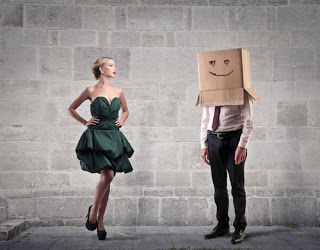
When the New York Times journo
asked Susan Cain (of the aforementioned TED talk and book) if, by choosing to
read a book in the car while their kids are at a school function, self-indulgent
introverts were actually just being rude – she laughingly agreed, saying sometimes “you have to
consider the other person’s point of view instead of getting wrapped up in your
own discomfort”.
Standing around in a bar talking about the weather (or in New Zealand,
where I grew up, rugby – which, bafflingly, seems to hold endless fascination for almost everyone)
isn’t exactly beneficial to anyone in a larger sense. But those awkward small
conversations can be the gateway to slightly larger interactions where people
do have an opportunity to express themselves. You may not necessarily be able
to offer practical assistance to someone complaining about the sleep
deprivation their seven-month-old son is inadvertently causing, but in listening to their
struggle you are offering emotional support. I believe that the greatest desire
of every person is to be seen, heard and understood. We facilitate this by
bearing witness to each other’s experiences and struggles, without judgement or unsought advice.
This is the simplest way we can show up for each other. As the saying goes, the
greatest problem with our communications is that we listen to reply instead of
listening to understand.
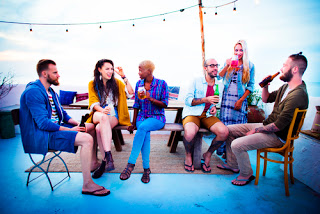 Even the act of simply smiling at someone is immensely powerful on an
energetic level. Mother Teresa said: “Every time you smile at someone it is an
action of love, a gift to that person, a beautiful thing.” All the love-heart
eye-emojis in the world sent from your living room won’t make someone feel as
good as a RL smile does. (OK, I’ve just re-read that it sounds reeeeally
cheesy... but you know what I mean, right?) The point is, we shine our
brightest when we are around other people. Not when we are on the couch alone, sucking
up our tea through a Tim-Tam straw (soz!). I want to continue to allow myself me time but I’m going to be tougher on myself when my urge to evade
social occasions comes up.
One for the sensitive types. How your weakness can be your strength

Confession: I hate parties. I’m awkward when it comes to small talk because I’m rubbish at ‘playing the game’, and I find meeting new people terrifying. Christmas parties are a battle of endurance for me, and summer barbecues with people I don’t know are acutely uncomfortable. For a long time I labelled this as shyness however I’ve realised that, yes, I am slow to relax in other people’s company and don’t enjoy talking about myself, but I actually don’t fit into the category of ‘shy’. I also attributed this mild social anxiety to being an introvert – which is true, I am – but this doesn’t completely explain my level of discomfort in social settings.
A month ago I read an
article in Elephant Journal that made all the pieces fall into place. My
preference for short, one-on-one interactions – or none at all – is nothing to
do with shyness or introversion, it’s all about being highly sensitive. It’s
about the way I respond to social exchanges on an emotional level.
This is what it means
to be highly sensitive:
* You need massive
amounts of time alone
* You pick up on
other people’s moods instantly, and usually absorb them
* You feel
overwhelmed by social situations and crowds
* You feel emotions
deeply
* You appreciate and
respond to art, music and beauty at a very deep level
That’s a tick, tick,
tick, tick and a half-tick for me.
The fact that I’m
highly sensitive means I can’t work for long periods in offices that are super
bitchy or super negative because that drags down my mood and drains my energy.
I can’t have a packed social calendar, because I need lots of time in solitude
to recharge. I can’t watch news footage of tragedies or disasters because I
am seized by intense despair. I can’t enjoy boxing or sports where violence
is encouraged because I find the aggression really confronting.
 In a society that
prizes physical dominance and discourages displays of emotion, sensitivity
is regarded as a weakness. I vividly recall being told: "Don’t be so
sensitive," as an adolescent when I complained about being bullied. (Um, thanks, really helpful. Nothing like a spot of victim shaming to avoid
tackling an issue.)
What I understand now
is that being sensitive is not a weakness, it’s a strength. It’s what helps me
to perceive, via my intuition, when people need help, extra kindness or just
space. It’s also the thing that allows me to tune into other people’s energy
fields to help them identify emotional blocks – hence my affinity with reiki and
angel card readings. (It also means I can be prone to taking those energies on
board, but I have measures to avoid that.)
Highly sensitive
types are the ones who create dazzling works of art, poetry and performance
that allow us to see the world in entirely new ways. They are terrible at
dating but excellent at long-term relationships. They have a small group of
friends who they forge strong connections with. They listen far more than they
speak. They are very protective of their personal space and don't react well to
being touched by strangers or people they don’t know well.
For me, being
sensitive means I need plenty of self-care. It’s about lots of sleep, lots of
water, lots of exercise, and lots of time on my own. It’s also vital to make
time to be creative and to be still. It feels good to be at an age where I
don’t have to make an excuse for choosing, and enjoying, these activities. I
know I feel better for them. I also do a shielding ritual as part of my daily
morning meditation, to protect myself, my physical space and my energetic
space. This means I can face the day knowing that no matter who I’m around, I’m
not going to get dragged down by their mood or their ‘stuff'’. (Happy to give
tips on this to anyone who’d like to know more about how to do this, just drop
me an email.)
If this post resonates with you, I hope you can find ways to embrace and nurture your sensitivity too.