
Things I learned about myself while travelling

I’ve recently returned from a holiday overseas, which was absolutely everything I needed it to be. Not only did the trip do the world of good for my health and wellbeing, but it also gave me plenty of opportunities for self-reflection. Here is some of what came to light.
I am better at dealing with unfamiliar situations than I used to be. I remember five
years ago when I was visiting Vancouver, I got hopelessly lost and became so
worked up about it that I couldn’t decipher my map. Embarrassingly, I started
crying. I did become lost several ttimes on this trip (it’s inevitable) and
although it was frustrating I noticed it no longer sends me into panic mode.
Which meant I was therefore more open to the opportunities it would open up.
And that’s because…

I am better at talking to strangers than I used to be. I will never be
entirely comfortable at meeting new people, but I have noticed that over the
past year I am less likely to freeze and stammer awkwardly than I used to be.
This sounds like a minor thing but what it shows me is that I am more
comfortable within myself than ever before.
Nice people are everywhere. They really are. Without me
asking (I have never been good at asking for help), people will detect that you
need assistance. I had people grab hold of one end of my suitcase when I was
struggling with it on the subway stairs. People approach me and offer guidance
when I was trying to work out which side of the avenue I needed to be on.
People walk up to me and start chatting when they saw me drinking alone. And
that was in New York – which I’d been led to believe was full of hard,
aggressive people.
More than being in a new location, it’s being out of your normal routine
that benefits you the most. In the absence of concerns about
work, relationship conflicts, household chores and general life admin, it’s
easier to be fully present in the moment. You soak in sights, smells and
energies that you don’t notice in your everyday world. You’re transported back
to a child-like state of wonder and life feels like an adventure again. Every
day I was away felt like it lasted at least two days, and it was glorious. Of
course it’s not possible for this to shape every day of your life, but I’d like
to find ways to bring back more wonder into my daily life and be more cognisant
of the beauty that makes up my world.
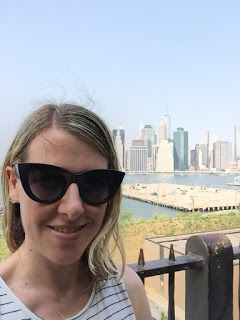 |
| Me, Brooklyn Heights, Manhattan behind me. |
I am essentially a good person. I noticed that whenever customer service clerks were rude to me, which was often, I would always endeavour to counter that with an overdose of politeness. I’d be lying if I said this wasn’t partially to draw attention to their rudeness. But mostly it was because I could tell they really needed someone to be nice to them. I’m being overly simplistic here because I don’t think there’s a need to dress this up: if you can spend time among rude people and not become rude yourself, you’re probably a good person.
Other people might take your holiday personally. I don’t mean
that literally, as in, other people will come along for the ride, but I have
found that many people processed my holiday stories and photos in relation to
their own lives, even though my trip had nothing to do with anyone else. When I
posted holiday photos (and I did limit them to two or three pictures a day),
some people would rush in and comment how they’d already been there and seen
that, as if this made them somehow superior. Some would openly say: ‘I’m so
jealous!’ Which I find baffling. (If you want a holiday, why don’t you just book
one? It’s not like I have something you can’t have.) And then when I returned, some people apparently thought I needed to be
brought down a peg or two, so without me even speaking they would make smirking comments like: ‘I bet you feel like
you never even left!’ and ‘you're not on holiday now!’ I’m not sure why some
people are resistant to other people having a good time. People are
weird.
What hope looks like. My experience of depression

Warning: this post
contains possible triggers for anyone with a history of depression or mental illness.
Last week's R U OK
Day campaign to raise awareness of suicide prevention has prompted me to write
a blog post about my experience with depression. It concerns me that despite
ongoing awareness campaigns, depression is still perceived as a weakness of the
spirit, and something that prompts us to collectively back away instead of
holding each other closer. I don't imagine my story will do much to change this
outrageously flawed and counter-intuitive approach but I think that the more of
us who share our stories, the less potent the notion that depression is
self-indulgent and trivial becomes. I hope.
I have devoted my working life to writing about matters that range from the sparkly to the gritty, yet I struggle to assemble
words that can even come close to accurately describing this incredibly bleak
period of my life. It was 2000. I was 20, and in my final year of a
communications degree at university. I was looking forward to a long-reaching, successful
career as a journalist and had no reason to believe that would not pan out as I dreamed. I believed that good things happened to good people,
crime happened only in TV shows and that New Zealand was the safest place in
the world. I was wrong about all of these things.
I was working at a
magazine part time while I studied (I've talked about that experience before). One bitterly
cold evening in June, a much-loved and respected colleague was walking home
from the bus stop when she was raped, repeatedly stabbed and left to die in a
suburban park by a man out on parole after serving time for a sexual assault. Her body was found later that evening. We were called into a
meeting the following day where volunteers from Victim Support (a truly
wonderful organisation) were on hand as our boss, in absolute pieces, explained
the horror that had unfolded overnight.

When you receive news
like this, your blood runs cold. You go into shock and you watch the room start
to spin and you wait to be told the police have made a mistake and actually
she's fine oh here she is of course she's OK what is this some sort of movie
this is absolutely not happening. But they hadn't and she wasn't.
My colleague and I
were mates – she was sort of a mentor to me – although we were not close. But more than the loss of her it was the brutal manner of her death that catapulted
me into depression, a fog so immense and terrifying it makes my hands shake to
detail it here. This tragedy caused a violent rupture in my foundations. I
ceased to function.
Although my memories
of this time are fairly hazy (self-preservation, I guess), I do remember that I
didn't eat for days at a time. I did not leave my bed for about three weeks – I
couldn't find a reason to. I occasionally slept but was tortured by nightmares
in which I was chased across town by sinister figures. I couldn't make decisions. I spoke
to no one. I forgot to go to classes; I forgot what day it was. Time meant nothing.
I had fallen off the edge of the world and I did not care where I
landed.
I was diagnosed with
depression and told to take anti-depressants which, because I was so broken, was a practical task I couldn't deal with. I was encouraged to attend counselling but I had nothing to say, about
anything. The world was dark and hostile and could never be anything else.
There was no point to anything. This, friends, is why depression is so
gravely destructive – if you don't care about anything, you stop participating in life. And that can lead you down a path of no return. Vastly more destructive than any physical injury I've ever had,
depression crippled my emotional nerve centre, rendering me unable to feel – and for a long time it felt like no person, activity or human experience could shift that.
I knew I needed help
but I didn't want it. I wanted to stay in my vacuum where I
would never feel pain again. I didn't want to participate in a world that could
be so unspeakably cruel.
I'm very fortunate
that my depression was circumstantial – it was prompted by a specific traumatic, grievous event, rather than the depression that fells
so many people throughout their lives for no reason at all, without reprieve.
When I started actually taking anti-depressants on a regular basis, they
changed the chemistry in my brain enough that I could start to face up to what
had happened (a process that took years) and slowly fumble my way through a powerful tide of emotions (and yes, I did eventually go to counselling). There
were searing rage, a stomach-twisting injustice and an overriding bitterness,
and there were agonising questions that will never be satisfactorily
answered.

I want to make it very clear that as immense as my despair was, I did not get to the point of wanting to take my own life. I cannot imagine the depths of hopelessness that brings people to that point, and I feel enormous sorrow for people in that situation, not to mention their families. What happened for me was that an unwillingness to cause pain to my sister, the person I love most in
this world, slowly started to ignite a desire to fight back against the darkness. my suffering was causing pain to the people I loved –but when you're depressed, your capacity to care about other people is disabled. Some people never get that prod – but that is not a failure on their part, it's just a reflection of the extent that this disease has them in its clutches.
It took months but I
eventually reached a point where I could imagine the possibility of
maybe experiencing joy again, even though it would be always feel tarnished in some
way. A smashed vase can be glued back together but the
cracks will always be faintly visible.
While my struggle
with depression is behind me now, it still casts a shadow over my
life. No matter where I am or what I am doing, in the background there lurks the threat that I will one day fall into that deep pit again – and
that this time, I will not be able to claw my way out. And since I'm being truly
honest here, this fear is a major contributor to my decision not to have children. I
cannot run the high risk of post-natal depression. (That said,
if I desperately wanted children I would probably be willing to take that
risk.)
This chapter of my
life is why I want us, collectively, to keep talking about depression. It is real and it is
ferocious – but we have each other and that is where we find hope.
This is why 'hope' is
my favourite word in the English language. It is why, two years later, I got a
phoenix tattooed on my back (something I regret, but that's another story!). It
is why I believe, in the words of Holocaust survivor Connie Ten Boom, that
there is no hole so deep that God's love is not deeper still. It does not
matter what God looks like to you – it only matters that you can find something
more powerful than the darkness. Hold on to that. That is what hope looks
like.
If you need to talk
to someone anonymously, at any time, call 13 11 14 (Australia), 800-442-HOPE (USA), 08457 90 90 90
(UK) or 0800 543 354 (New Zealand).


The law of attraction. Does it work? YES. Well, most of the time...

When Jim Carrey was a
struggling actor, he wrote himself a cheque for $10 million for “acting
services rendered”, dating it 10 years from that date. He did this because,
despite growing up in poverty (his family lived in a car at one point), he
believed he could hit the big time as an actor. And he did. Within 10 years he
was earning millions for films such as Ace Ventura and The Mask.
This story is a
wonderful illustration of how much power we have to manifest what we want.
That’s a message that comes up in angel card readings all the time, and a
concept that I’ve used in my own life to get what I had my heart set on.
Sometimes it worked, sometimes it didn’t. Alas, this approach is not guaranteed – which can be disappointing. Here are my thoughts on why.
If you read The
Secret when it came out a decade ago, you’re probably familiar with
the law of attraction (I didn’t; I found it too gimmicky). Here’s the concept in a nutshell: whatever you
want, you can attract through your thoughts. If you focus on what you don’t
want, you’ll block what you want, and probably attract what you don’t.
Here’s how I’ve used
the law of attraction to manifest specific things:
 * When I needed a car
in 2010, I was fearful of buying a car that would break down on me, so I asked the Universe to find me a
car like my friend owned, which was cheap to run and super reliable. Within a
few days I had spotted that model of car on the side of the road near my house
with a ‘for sale’ sign in the window. My dad checked it out and said it was a good buy, so I put
in a low offer and got it. Too easy! That car is now owned by my brother and
despite being more than 20 years old, it has yet to fail a warrant of fitness.
* When I moved back to
Sydney last year I was nervous about making friends. As an introvert, social situations are challenging for me. I visualised myself
encircled by a group of friends and laughing – and I returned my thoughts to this vision
time and time again. A month after I arrived, the angels drew my attention to a
newspaper story about a new social group that had started. I joined the group and within
two months I had found myself part of a group of friends who are awesome, and
have made me feel like I belong here.
On the other hand,
sometimes the law of attraction has not delivered. This
can happen because sometimes things that we think we need are actually not right for
us. I wouldn’t, for example, recommend focusing on manifesting a winning
lottery ticket. Even though you might think a truckload of money is exactly
what you need for a better life, the Universe knows better. (Yes, it worked for
Jim Carrey, but his goal was more about career success than the financial
payoff.)

I have focused on
attracting a wonderful man into my life for about four years now, without success.
However I can see now that the timing was wrong – I wasn’t ready for a healthy relationship, even though I thought I was. I had so much
work to do on myself, in particular, bolstering my woefully low self-esteem (my neediness was hardly an attractive quality). If I’d been in a long-term relationship,
I would never have embarked on the journey of personal development that has
brought me to where I am now. Not only am I now a more independent, resourceful
person who knows that happiness and love are derived from within me rather than
in a relationship, I’ve also forged a more fulfilling career in the spiritual realm. I would never have taken this direction I hadn’t delved within to find
answers to my own discontentment.
And that’s the thing
about the law of attraction – while we do have the power to attract what we
want, what we want might not be in our
best interests. And we don’t have any say in the timing.
This is why I’m wary of self-help books and wellness bloggers that promise you can have anything you want if you just think positive. This philosophy can lead to disappointment and disillusionment. (I’ve written about the inflated promises dolled out by some sectors of the self-help industry before, read my blog post here.)
Keep believing,
people. The law of attraction isn’t a perfect mail order system but it
*does* work. (Eventually.)
I’d love to hear how the law of attraction has
worked for you. Email me if you’d like to share your story.
Why being lonely is so dangerous
 There’s a fairly
well-to-do woman in her early 60s living underneath me, who keeps ‘accidentally
running into me’ when I exit the lift. Her favourite thing to do when she
pounces is to run through an ever-changing litany of complaints, which may
include: the way the man living on the level above me waters his plants (too
overflowy!), the jazz music the pub down the street plays on Sunday afternoons
(too jazzy!), a water pipe between my unit and hers (God knows what her issue
is with that – it’s not even leaking). Eventually I figured out her complaints
are not borne of dissatisfaction but a more powerful and very dangerous emotion
– loneliness.
Research shows that loneliness
is as ruinous to your health as smoking. It raises your blood pressure and
cholesterol, suppresses your immunity (making you vulnerable to disease) and increases
your risk of heart disease, because your body is under constant stress.
It’s estimated that
more than 40 per cent of us will feel the pang of loneliness at some point. And
being in a long-term relationship is no protection – research shows
that more than 60 per cent of lonely people are married. I can’t imagine
the misery of being in a relationship with someone you feel disconnected from.
The common thread
that underpins loneliness is a lack of connection. That might be
geographic – moving to a city far away from your loved ones, for example – or
it might be emotion driven – feeling like your friends don’t understand you, or
that everyone around you is having different experiences to you (such as having
children when you’re unable to).
For me personally,
the threat of loneliness has always been far more damaging than the emotion
itself. Being an introvert, I’m actually pretty content with solitude. But the
idea that having only myself for company could be enforced rather than a choice
has, at times, gripped me with terror. This has resulted in some poor choices –
going out on dates with men who bore me, remaining friends with people who I
have nothing in common with, to name two.

This fear is not as
strong for me now because as I’ve grown older I’ve come to understand that being alone does not equate to being lonely.
And at an age where most people’s social networks are reducing as they focus
more on their family units, I’ve made a conscious effort to expand my circles
of friends, because I’ve realised how much these connections add to my life.
This includes volunteer work at retirement homes, joining a social club and,
yes, this blog – which has made me realise I have a great deal in common with a
great deal of people. I think, too, that becoming more comfortable with being
myself has helped me connect with people on a deeper level while also
developing an awareness that isolation is really an illusion.
For all these reasons
I don’t give my whingeing neighbour the brush-off, although I can’t say
spending time with her is a joy. And I’m not sure that me feigning interest in
her chatter out of a sense of obligation is beneficial to her. But I try to
keep in mind that loneliness is a miserable emotion and it can make us do unhealthy and unhelpful things – like complain
(which tends to repel people). I can only hope that having some understanding
of the mechanics of loneliness will help me to be more proactive about taking
steps to prevent it when I get to her age and beyond.