Trudie McConnochie Trudie McConnochie

On 'Sliding Doors' and living with regret

Have you ever wondered about how different your life might have been if you’d made different choices? Of course you have – you’re human. So here’s a more challenging question: how attached are you to that imagined life? What I mean is, does imagining something different cause you to view your real life with resentment or bitterness?

Recently I rewatched the 1998 movie Sliding Doors and it got me thinking about regret and the lives we might have otherwise lived.

(Photo by Verne Ho on Unsplash)

(Photo by Verne Ho on Unsplash)

Have you ever wondered about how different your life might have been if you’d made different choices in your past? Of course you have – you’re human. So here’s a more challenging question: how attached are you to that imagined life? What I mean is, does imagining something different cause you to view your actuallife with resentment or bitterness?

Recently I rewatched the 1998 movie Sliding Doors and it got me thinking about regret and the lives we might have otherwise lived. In case you can’t quite remember it (well, it did come out 21 years ago!), the film explores two different life paths following Gwyneth Paltrow’s character either catching or missing a particular train. In one narrative, she gets home in time to find her partner cheating, moves out, gets a sassy haircut, starts her own business, falls for a new boyfriend and takes control of her life. In the other, she gets home too late to witness the cheating, and her doormat-y life continues more or less as it had (until the twist at the end). What made Sliding Doors so enticing to audiences, I suspect, was that it invited us to fantasise about an alternative life we could have had if only fate had steered us in a different direction.

(Photo by Robert Tudor on Unsplash)

(Photo by Robert Tudor on Unsplash)

Here’s the thing about fantasies: they keep us from being grounded in the lives we *do* have. When we invest emotionally in a fantasy, we’re tacitly agreeing to be passive observers rather than active participants in creating our futures. Sliding Doors made it look like fate determines the course of our lives, and that’s simply not true. We are the ones in charge, and the Universe is there to work with us. (Read more about this in my ‘Who’s in charge?’ post.)

In one of her much-loved Dear Sugar columns for The Rumpus, Cheryl Strayed wrote: “I’ll never know, and neither will you, of the life you don’t choose. We’ll only know that whatever that sister life was, it was important and beautiful and not ours. It was the ghost ship that didn’t carry us. There’s nothing to do but salute it from the shore.”

I love the way she acknowledges the appeal of a fantasy life and how captivating it can be, but also recognises that ruminating over it can be detrimental.

So many of my clients tell me how heavily the burden of regret weighs on them. One client had spent years shaming herself for choosing something that seemed right at the time but which, she felt, had got her to a point in her life where she no longer wanted to be. She was stuck on the idea that she had ruined, or at least hampered, her life. She was attached to the idea of the life she would/should/could have been living right now if she’d made different choices. This is the great lie that shame tells us all. In truth, there is no alternative life. All of us are where we are because that is where we’re meant to be. But we don’t have to stay there.

(Photo by David Valuja on Unsplash)

(Photo by David Valuja on Unsplash)

Last year, when I was writing a feature about regret (I’m also a freelance journalist), I interviewed a life coach who told me that regrets about the past are often a tactic employed to avoid the present. She told me: “It’s easy to go, ‘it was so fantastic with that boyfriend when I was 23’, but there was a reason that that didn’t work out. It’s really easy to click into the ‘grass is greener’ scenario. [But] there’s no way that we can make changes without going into whatever’s in the present that we’re trying to avoid.”

It’s an important point. When we’re lamenting the past or investing energy into an alternative life, we’re giving away our power. We’re holding onto a fantasy and giving ourselves licence to stay stuck in sorrow for something that was – in truth – never meant to be. You’re entitled to your sorrow, but if you let that rob your present of joy, you’re doing yourself a disservice.

(Photo by Eli DeFaria on Unsplash)

(Photo by Eli DeFaria on Unsplash)

For better or worse, you are exactly where you are supposed to be. You made the choices you made because you didn’t know then what you know now. And if you’re not happy where you are right now, that’s a good thing – because you have the power to change it. The only way to turn your life around is to face up to the ways your current life is falling short, and commit to making changes over time. That’s a narrative you’re unlikely to see in film, but it may help you make great strides towards the life that you want.


*If you need help turning your life around, talk to me about how energy healing can help you clear blocks to success and manifest a better reality. Click here to find out more.

Read More
Onegroundedangel Onegroundedangel

I’m going home. All I want for Christmas is… peace

Girl on railway tracks with suitcase
In a recent post I talked about the tension and pain that can occur at family gatherings over the holiday period. This post is on a similar theme. It’s about returning to your hometown, which I’m about to do, and how that can stir up a complicated mix of memories that be both comforting and confronting.
Geographical places carry vibrations all their own. This is why you can visit a location and instantly feel at home there, while other cities leave you cold or feeling on guard.

I have great affection for the town I grew up in. I could not live there again – it’s too small for me, and I get bored there – but I love returning and immersing myself in its sleepy, beachy vibe. It’s the place where my internal compass resets to true north. Of course it helps that many of my favourite humans and dogs reside there.
However, many of my other favourite humans live in a city that raises my heart rate for all the wrong reasons. This place makes me feel on edge. I lived there for 11 years, all up, but never felt a connection with it. There’s nothing inherently wrong with this city. In fact, there’s a lot that’s right with it. It boasts beautiful coastlines, wide skies and expansive parks. But it just never felt right for me. Living there was like putting on a coat every morning that didn’t sit right on my shoulders and didn’t hang close enough to keep me warm. Although I made some wonderful friends in my time there, I never felt like I truly belonged in that city.
I am nervous about returning to this place over the Christmas period because the last two years that I lived there, I was miserable. It is difficult for me to separate my feelings about all that is great about this city from the way it made me feel (not that I’m blaming the city for that!).  When I go back there, my past sadness tugs at my sleeves. It’s a weighty, intangible thing that bounces between the volcanoes, striking an echo only I can hear. I’ve visited only once since I moved to Sydney, and although I loved catching up with friends and was sad to say goodbye to them, I could not wait to leave.
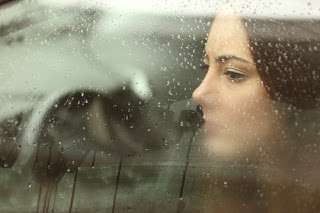
Woman looking sad through car window
This time I have planned my trip to make sure that peace, not unease, is my overall experience. I fly in close to Christmas so that I can head straight to my hometown. I have limited the amount of time I spend in the city after Christmas and am making sure I only catch up with people who I truly want to see, as opposed to people I feel obliged to see. This time around, there are no big gatherings at pubs or cafes. I am only seeing people on a one-to-one basis, mostly at their homes or at beaches, where we can have solid conversations and actually connect.
Of course there will still be some encounters that leave me feeling uncomfortable. You cannot, after all, edit experiences – life is not an Instagram feed (unfortunately). The past is a nice place to visit but you cannot stay there. And I think that’s for the best. 

I wish you peace this holiday period. Wherever you go, whoever you see, I hope that you remember to carry peace with you. Hold on to that. 
Read More
Onegroundedangel Onegroundedangel

Making peace with the past, and its scars

In the process of writing last week’s post about transformation I started thinking about my phoenix tattoo, which got me thinking about regret and acceptance.
The phoenix is, of course, a potent symbol of transformation. It’s the mythical bird that rises from the ashes after adversity. The caterpillar emerging from its cocoon into a beautiful butterfly. You get the idea. 
I was certainly making a statement when I chose to get a phoenix tattooed on my upper back at the age of 22. I was also ahead of my time, as Ben Affleck has just done the very same (although his is more colourful and impressive).

To give you some background, at the time I got inked, I had come through the other side of a battle with depression and a redundancy. I wanted to carry a mark that would symbolise my resilience and inner strength. I hoped it would give me something to draw on in challenging times. I believed, in the naïve way that only a 22-year-old could, that I was through my biggest personal crisis. I did not then understand that life is a series of challenges and strength building, and that we are reborn again and again and again (unless, of course, we choose to stay stuck).
Instead of being a badge of honour, the tattoo became a source of regret. It didn’t remind me of my transformation, it only reminded me of the misery that had permeated that chapter of my life. I felt disappointed that I had not grown enough to become the person I had believed I could be on day in a dingy Auckland tattoo studio. Plus, it was kinda ugly. 
So, in my early 30s I decided to have it removed. Unfortunately the laser treatment process was excruciating (vastly more painful that the tattooing process), and was predicted to become more so as treatment progressed. It was also costly. So after five treatments I decided to make peace with the now slightly faded bird, and quit treatment. 
My tattoo removal story in Women's Health magazine
I totally understand how people who have tattoos of their ex’s name on their forearms, or Kermit the Frog tattoos on their butt (I actually know someone in this situation), would want to have those removed. But my tattoo wasn’t that awful. So why had I wanted it erased so badly?
What I’d been trying to do was the equivalent of what people do on Instagram every day – edit out the ugly side and present only the elements of myself that I wanted to be seen. I knew that getting rid of the tattoo would not alter the course of my history, but at least it would mean I wouldn’t have to keep reflecting on it – because every time someone saw the tattoo I had had to explain (in the vaguest of terms) that I had been through “a rough period”. In doing so I was invoking the heavy energy around that period once again. I felt a whiff of the despair and, just like a dementor in Harry Potter, its darkness loomed large. I didn’t want to be dragged down by that chapter any longer. I wanted to put that behind me once and for all. 

So very idealistic.
The past is ugly. It has shadows and it leaves scars. It cannot be erased – even with the heat of a laser. The challenge for me has been in finding a middle ground between acceptance and regret. More than a tattoo could, it was in writing about my battle with depression that I finally made peace with the parts of myself from which I had bled so profusely (read that post here). I now neither embrace nor recoil from reminders of my past struggles. I have taken the lessons and am doing my best to gently move on. I have regrets, but I no longer ruminate on them.

We are all better off for what we’ve been through, good and bad. That’s the unsightly truth.
Read More
Onegroundedangel Onegroundedangel

Regrets? I've had a few. Nothing wrong with that

Girl looking sad and remorseful

I’m always suspicious of people who declare that they have no regrets.
I bet you know someone who has stated, with a sense of pride: “If I had to do it all again, I wouldn’t change anything.”

Really? Sure about that? You wouldn’t decide to wear a different dress to your mate’s 21st so you didn’t turn up wearing the same thing as his girlfriend? You wouldn’t have avoided that pothole so you didn’t hit a tree and write off your car? You wouldn’t have ended your dead-end relationship sooner so you could have been happier earlier? You wouldn’t have applied sunscreen every single day so you didn’t end up with an alarming amount of wrinkles in your 30s? (That sunscreen song from the 90s was right about UV protection, you know).You wouldn’t change anything? 
I don’t believe you.
Let me tell you, there isn’t much I wouldn’t change if I could. 
I would back myself and aim higher in my career instead of opting to float in the achievement-free zone of freelancing, so that I would have something to show for the past five years, to name just one.
I totally understand that everything that has happened has shaped my life and my character for the better, and that I couldn’t have learned the lessons I’ve learned any other way. The suffering was necessary then, but it is not necessary now. I also understand that regret is unhealthy – not to mention unhelpful, considering we have no means of turning back time (still hanging out for that time-machine technology, Doc).
I know all this, and yet I still have regrets – but I don’t regard that as a bad thing. 
Girl on swing by herself
A lot of spiritual people bang on about embracing your past, warts and all, and how liberating this is. I’m sure it probably is, but I don’t think it’s realistic, or even necessary. 
Personally, I don’t think there’s anything wrong with acknowledging that things have not worked out the way you had hoped. I do agree, though, that holding on to pain around what’s happened will hold you back. 
So here’s my approach. Instead of embarking on a futile mission to embrace all that shitty stuff, I’m working on acceptance. I can’t change what I’ve done, or what’s been done to me, but I absolutely can change how much I let those things affect me now. I see acceptance as a middle ground between celebrating unsavoury events and languishing in regret. What this means is freedom from self-flagellation over my choices, without labouring under the delusion that I should* be happy about things that did not, and never will, make me happy. 
It’s possible to be grateful for the lessons while still wishing their circumstances had been different.
If something sucks, I’m not going to pretend otherwise. You can’t put glitter on a poo, as an old editor of mine used to say (he was talking about a poorly written story, but the same message applies here). This doesn’t mean playing the ‘if only’ game though. Everything is not awesome, but it is OK. Maybe we should just focus on that. 


*I hate the word ‘should’ – it’s loaded with so much expectation and a sense that you are failing at something – and I use it sparingly. In this case I think it was warranted. 
Read More