Salute to people who speak from their hearts

I've been thinking a lot about speaking our truth, and the potential ramifications of that. This is something that we've seen come up in the news lately, with Bruce Jenner's tell-all interview, and here in Australia, a sports reporter hit headlines for pointing out some uncomfortable  but valid  truths about war in a series of tweets. 
In the case of Bruce, his honest account of transitioning has earned him praise for his bravado. In the case of the sports reporter, he was slammed for being disrespectful to our armed forces and lost his job. 
In a completely different category, I recently read an incredibly candid first-person account of a young American girl living with herpes. Instead of hiding away, she has written a blog about the challenges of carrying a transmittable disease with such social stigma. Through her candour, she is helping to slowly rid the taboo around this condition, one reader at a time.
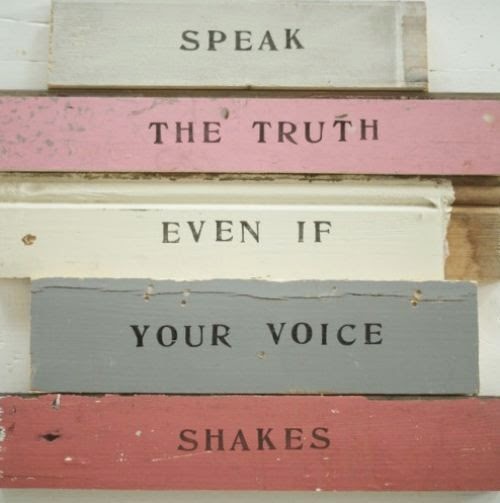
These situations are very different, but there's a common thread  a willingness to speak the truth, even though it’s uncomfortable and risky. It would have been easy for these individuals to stay silent out of a fear of rocking the boat, but for their own reasons, they spoke up and said what they believed needed to be said. In a society that worships conformity, this is an act of radical courage. 
In order to do this, they had to let go of expectation or fear about how other people would respond. They had to embrace the uncertainty of what consequences their truth telling would have. They had to decide that the cost of not speaking their truth was greater than any adverse effects of standing up for who they are and what they belief.
This is such a powerful thing to do. It isn't about forcing your opinions on other people, it's about being
Woman on swing in sunset
authentic about who you are and what is right for you. It isn't, either, a licence to offend people or cause ill feeling. 
Being authentic is about not contributing to bitchy conversations your workmates are engaged in, that make you uncomfortable. Not sticking with a career that your parents expected you to do, but you’re bored with. Not going to the pub every Saturday night/Sunday morning with your mates when you’d rather be at home doing a jigsaw puzzle. You can speak your truth without being provocative or offensive. It takes practise and it takes self-belief but there are always people willing to show us that it's possible – and beneficial – to choose the path that honours your own light. If you don't, you're doing yourself an enormous disservice. Life is short, but it'll feel very long if you're committed to being someone, or everyone, else. 


The planets are throwing you a curveball. Just roll with it

Phases of the moonThere are a lot of intense energies around right now, and you can blame the moon and planets for that. I have to say, I do find it quite bizarre that I'm writing a blog post about this as it seems like something that few people would be on board with, but every time I mention full moons or planetary events, my blog traffic spikes. So it seems that a lot of you really do notice, and care about, astrological dynamics. 
But perhaps that's not surprising. Even people who are dismissive of spiritual concepts seem to be aware that the full moon has an impact on human behaviour (nope, not talking about werewolves!). 

A policeman I used to know told me that incidences of violence and disorderly behaviour have a massive increase during a full moon – to the point where cops in his station were wary about being rostered on for night shift at full moon. And many emergency room doctors can attest to a similar effect. That’s because the moon is associated with our emotions, and some people don’t process highly intense emotions in healthy or respectful ways.
BTW I'm not an astrologer. Everything I've written here is collected from what I've read lately (I'm fascinated by this stuff). And remember that you can't actually blame the moon for your behaviour  even though we are influenced by different energies, we are all responsible for our own actions. 
The full moon this week (it started on Monday night) is extra intense because it's in the house of Scorpio – that's the sign associated with deep thinking and emotions. If you know a Scorpio well (I'm one!), you'll know what I'm talking about – we're all about delving into what's really going on, and exploring what actually matters. You will never have a conversation about the Kardashians with a Scorpio – shallowness bores us to tears.
So if you're feeling extra emotional this week, and you're being confronted with deep issues you've been burying or simply hadn't been aware of, that's the full moon at play. The good news is, it's shining a light on stuff you need to process and clear. It’d be helpful to take that on board. 
But wait, there's more! We're also in the shadow period of the Mercury retrograde – something that happens three times this year. The retrograde proper starts on May 18 but its effects start to be felt in the two-week lead-up. The planet Mercury is to do with communication and travel, so when it goes into retrograde (until June 11) it can wreak havoc. This is a time when your computer may melt down*, emails go missing in cyberspace, buses and flights will constantly be delayed and you'll get caught in unexpected and inexplicable traffic snarl-ups. Last year during a Mercury retrograde, the whole of Sydney Airport lost power for three hours, for reasons officials could not identify, sending the entire flight schedule into disarray for the day. And in the Mercury retrograde in January this year, a leading telco in Australia randomly changed its entire network into daylight savings time, meaning that people living in states which do not observe daylight savings – hello, Queensland! – got woken up an hour before they should have been, and rocked up to work early (robbed of an hour's sleep –how gutted would you be?!).
Also during Mercury retrograde, your interactions with others may be fraught. You'll find yourself – and them – saying things you don't mean. Misunderstandings will be commonplace, and will cause conflicts. Your thoughts will be muddied and you'll struggle to get your message across. In short, this planet is a bit of a shit-stirrer.
But it has a fun side too – Mercury is also associated with playfulness, so fun activities that have maximum laugh value are highlighted over this period. Channel that inner child – there's a trampoline and a silly movie with your name on it. 
The best way to get through a Mercury retrograde cycle is to be patient. Be forgiving of people around you – especially when it comes to communications. Focus on ways to find calm – meditation, herbal tea, long walks in the park, whatever floats your boat – as this is more important now than ever. 
The planet Mercury up close.
If you still don't believe in this astrological stuff, I get it – it does seem pretty far-fetched. But remember that everything is made of energy, which, by its nature, is subject to ebbs and flows. Emotions themselves are a form of energy. So it makes sense that what happens in the solar system, with its associated powerful forces, could also affect energy flow within and around us. The moon controls the tides, so it stands to reason that the moon could also affect the flow of emotions within our body – especially when you consider that our bodies are about 75 per cent water, an element which is associated with emotions (that's why Scorpio, Cancer and Pisces, the water signs, are the emotion-driven signs of the Zodiac). Oh, I've lost you, haven't I? Too airy-fairy? Yeah, I know, it's pretty out there. But do try to keep an open mind. 

* Pro tip: if you haven't done a computer back-up recently, do it now. 

Forget FOMO, look for JOMO – joy of missing out. (Let me know if you find it)

Do you suffer from FOMO? You might like to know that that’s out of fashion now (sorry). Apparently it's all about JOMO now – in case you are as deeply uncool as I am, that's the Joy Of Missing Out.
The terminology may be new to me, but the concept certainly holds appeal. Unfortunately my long-held pattern of comparing myself to others presents a challenge. 
The joy of missing out essentially means being happy with what you have right now, and not wishing you had someone else's life – someone more glamorous, more popular, more successful. (This isn't, however, the same as staying stagnant and not pushing yourself towards your dreams.) It means being OK with sitting on the couch on a Saturday night devouring corn chips and watching The Big C box set while your friends are posting party pics on Facebook. And being OK with that because you have other things to look forward to. That’s next-level contentment, right there.
It comes back to acceptance. If you're happy with where your life is at – or even if you're not, but you believe it will change – you have no need to compare yourself with others. If you can nail that, missing out really could be a joy.
I like this. I wish I could honestly look at other people's lives and not feel that I am missing out. Back in early January I wrote about my struggle with comparison on social media. Well, I'm still struggling (clearly). Maybe I always will.                
Two months ago I felt so miserable about how my life compared to other people (ie unfavourably) that I
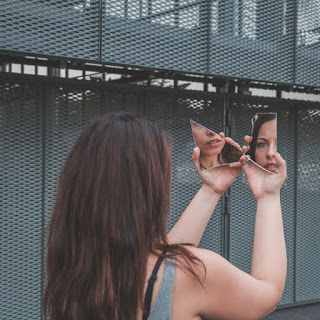
Girl looking into broken mirror
decided the best solution was to unfollow all the people on Instagram who were doing life better than me. People on incredible trips overseas. People loved up, and flaunting it (which they're perfectly entitled to do). People with strong eyebrow game. This seemed like such a good idea!
It was a terrible idea. 
In my defence, I was the far side of a bottle of shiraz at the time. But, still. While many of these people were high profile, some were regular people… my friends. One of my mates called me out on this – and good on her – by asking why I'd cut her off. Ouch. I still have not been able to bring myself to refollow these people – it's just too embarrassing. How do I explain? "Sorry for unfollowing you, I was feeling inadequate and jealous." Yeah, that'll go down well. 
I'm well aware that what we see on social media are very carefully curated snippets of people’s lives that are not indicative of their reality. I know this, and yet, I still find myself comparing my behind the scenes with the beautiful peoples highlights reels, as the saying goes. Also, removing the triggers (ie people whom I might envy at any given moment) from my eyeline is hardly going to help me resolve the root problem: a lack of self-acceptance.
Self-acceptance is something that comes up for me time after time in my reiki sessions, so I know that this, or a lack thereof, is playing a big part in holding me back. No matter how many times I tell myself that I AM good enough, I struggle to completely believe it. As yet, I have not found a way to shift this block in my thinking.
I know it is up to me, and that I’m not powerless, but right now I’m struggling to figure out how to move forward on this.
JOMO? I’ll aim for JO-maybe.

Regrets? I've had a few. Nothing wrong with that

Girl looking sad and remorseful

I’m always suspicious of people who declare that they have no regrets.
I bet you know someone who has stated, with a sense of pride: “If I had to do it all again, I wouldn’t change anything.”

Really? Sure about that? You wouldn’t decide to wear a different dress to your mate’s 21st so you didn’t turn up wearing the same thing as his girlfriend? You wouldn’t have avoided that pothole so you didn’t hit a tree and write off your car? You wouldn’t have ended your dead-end relationship sooner so you could have been happier earlier? You wouldn’t have applied sunscreen every single day so you didn’t end up with an alarming amount of wrinkles in your 30s? (That sunscreen song from the 90s was right about UV protection, you know).You wouldn’t change anything? 
I don’t believe you.
Let me tell you, there isn’t much I wouldn’t change if I could. 
I would back myself and aim higher in my career instead of opting to float in the achievement-free zone of freelancing, so that I would have something to show for the past five years, to name just one.
I totally understand that everything that has happened has shaped my life and my character for the better, and that I couldn’t have learned the lessons I’ve learned any other way. The suffering was necessary then, but it is not necessary now. I also understand that regret is unhealthy – not to mention unhelpful, considering we have no means of turning back time (still hanging out for that time-machine technology, Doc).
I know all this, and yet I still have regrets – but I don’t regard that as a bad thing. 
Girl on swing by herself
A lot of spiritual people bang on about embracing your past, warts and all, and how liberating this is. I’m sure it probably is, but I don’t think it’s realistic, or even necessary. 
Personally, I don’t think there’s anything wrong with acknowledging that things have not worked out the way you had hoped. I do agree, though, that holding on to pain around what’s happened will hold you back. 
So here’s my approach. Instead of embarking on a futile mission to embrace all that shitty stuff, I’m working on acceptance. I can’t change what I’ve done, or what’s been done to me, but I absolutely can change how much I let those things affect me now. I see acceptance as a middle ground between celebrating unsavoury events and languishing in regret. What this means is freedom from self-flagellation over my choices, without labouring under the delusion that I should* be happy about things that did not, and never will, make me happy. 
It’s possible to be grateful for the lessons while still wishing their circumstances had been different.
If something sucks, I’m not going to pretend otherwise. You can’t put glitter on a poo, as an old editor of mine used to say (he was talking about a poorly written story, but the same message applies here). This doesn’t mean playing the ‘if only’ game though. Everything is not awesome, but it is OK. Maybe we should just focus on that. 


*I hate the word should’ – it’s loaded with so much expectation and a sense that you are failing at something – and I use it sparingly. In this case I think it was warranted. 

Just listen. It's all anyone needs you to do

Donkey with big earsTechnology might make it easier for us to forge new connections as well as maintain relationships with those who are far away, but it’s also eroding relationships with those who are close to us. In his book Focus, leading US psychologist Daniel Goleman (whose work is fascinating, BTW) has written about how technology is killing our attention spans. We are so used to the barrage of information presented to us that we lose interest when forced to focus on just one thing, or one person. What that means for relationships is this: “Being able to focus on the other person rather than the text you just received has become the new fundamental requirement for having a relationship with that person,” Daniel says.

The reason I bring this up is not to lament our increasingly scattered and superficial social interactions – although that is concerning – but to reflect on a really important facet of relationships that I feel I am in danger of forgetting how to do: listening.


It does feel, at least to me, that it’s harder than ever to be fully engaged in a conversation with someone else, and the influence of so much competing stimuli is surely part of the problem. (Although to be fair, I’ve always had a short attention span.) To be fully engaged in a conversation means listening – really listening – to the other person, which is as important in our interactions people we know as it is with those we don’t.

A few weeks ago I was on a bus trip home, writing in my notebook, when an old man sitting next to me suddenly asked me what I was focusing on so intently. This started a conversation that lasted the entire journey home and covered: handwriting styles, the best and worst places in the world we’d each visited and the history of the suburbs we were travelling through. I realised how bewildering it must be to someone of his generation to see everyone staring at their phones or listening to music – anything but engaging with the people and places around them. Everyone is trying to be somewhere other than where they are. As I got off the bus he thanked me for listening and said how much he’d enjoyed our chat (I had too).

This was an important reminder that giving someone our complete attention, and really taking in what they’re saying, is such a beautiful and underrated thing to do. Dave Isay, winner of the 2015 TED Prize, describes listening as an act of generosity and love. StoryCorps is a project Dave founded where two people who know each other sit in a mobile recording booth with a facilitator for 40 minutes of conversation. Essentially, they interview each other – many treating this as a ‘what I would say if this was our last conversation together’ scenario – and what comes out of that is a new understanding about the other person and a deeper connection to them. A recording of their conversation is available for a fee to cover costs. Dave is now developing an app to allow people to have these meaningful conversations at home.

“So much of how we communicate is fleeting and inconsequential,” says Dave in his TED talk. “I’ve learned about the poetry and wisdom and grace that can be found in the words of people all around us when we simply take the time to listen.”

What I’ve been reminded of lately how powerful the simple act of listening is. All anyone wants is to be heard. To be understood, yes, but most importantly to be heard. Our ears are as important in meaningful interactions as our hearts are. By listening to someone – whether it’s a random man on the bus or your significant other – you are bringing integrity to that exchange, affirming that that person matters and validating their human experience. That is the best gift you could give anyone. I hope, that in an age with so much competing for our attention, I never forget how to do that.