
The great pretender: imposter syndrome, and the fear of being found out
I used to have a friend who held a prestigious, high-powered
job in magazines. She was great at it, too – but she didn’t think so. She once
confided to me that she lived in terror that someday someone would tap her on
the shoulder and ask her to leave, telling her they’d figured out she wasn’t up
to the job after all.
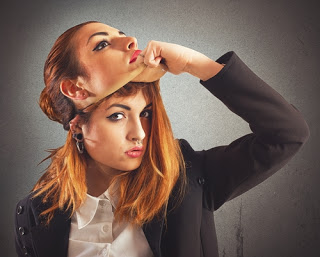
This is what imposter syndrome looks like. At heart,
it’s the belief that you’re not good enough, and it typically involves a deep fear
that your inadequacy will be uncovered, probably in dramatic fashion. It’s
typically experienced by more women than men, because we are, according to
experts, more likely to recognise our faults (I’ll just park that statement
without further comment).
Imposter syndrome has got naught to do with your actual
performance or skills, it’s solely about an internal conflict, a deep suspicion
that you’ve somehow hoodwinked everyone into letting you have this job or
partnership, and they’re going to find out the truth about you very soon and
your entire life will implode.
Whenever we’re dealing with a fear – particularly one like
this, which has no logical foundation – the first most helpful thing we can do
is remind ourselves we’re not alone. Fear is a projection of the ego, not the
soul, and the ego is all about separating us from others. And you’re not alone,
truly. More than 70 per cent of people have experienced feelings of
fraudulence. That’s *feelings* of fraudulence, not actual fraudulence.
 Imposter syndrome thrives on blissful ignorance of the
facts. It ignores that your employer put you in this position because they
think you’re good enough. It ignores that you’ve already turned in work of a
high, or at least passable, standard. Reality check: even if you don’t feel
like you know what you’re doing (which is probably not true), you know enough
to be in the position you’re in, and there’s no reason you can’t learn more
from that platform. You are already good, but it’s your willingness to keep
going in the face of fear and all its stupid stories that makes you great.
The truth is, no one knows what the hell they’re
doing, most of the time. Fake it ‘till you make it is an entirely reasonable
work philosophy. In this life, we’re all making it up as we go along – anyone
who is a parent can vouch for this. Expecting ourselves to be ace at everything
is just another way we covertly bully ourselves. So, so unhelpful.
If a fear that your staff don’t rate you as a manager
is a source of anxiety for you, try to remember that what other people think of
you is none of your business. I know, I know… you *want* them to feel confident
in your abilities so they do their best work, but ultimately that’s up to them,
not you. The only thing within your control is, not the way others feel about
you, but the way you feel about yourself. And if imposter syndrome is an issue for
you, perhaps you need to do some work on bolstering that (don’t we all!).
Although I haven’t experienced imposter syndrome
myself, I’m very familiar with the feeling of inadequacy. My feelings of
unworthiness in any given situation generally stem from my tendency to compare
myself to others, and as a result, finding myself lacking. Like this: ‘She’s so
outgoing and funny and popular, and I’m so dull and awkward.’ In all honesty I
don’t know whether there will ever be a point at which I will ever totally
recognise my own worth – I doubt we as humans can ever fully understand our own
power in this lifetime – so instead of focusing on what it is I perceive that
I’m lacking, I try to look at what I do have. Not in a ‘well she may be pretty
but I’m this and that…’ type of way, more just a general counting of my
blessings without using anyone else as a reference point. This strategy has been working really well for me. In spiritual truth, none of
us really lacks anything – we are all complete. Different, but wholly
everything that we need to be.

What I’ve found helpful when it comes to getting on
top of my comparison tendency has been turning it on its head by comparing
myself with… myself. Looking back at the person I was six months, a year or two
years ago, and taking a moment to appreciate how my emotional responses and
behaviours have changed and matured gives me a sense of value. I don’t need to
be the best, I just need to be better than I was. And I am, every day. And I
know that you are too. (Better than yourself, I mean. Not better than me, obvs.
Although you could be. Hey, let’s not compete, OK?)
Does social media make us narcissists? No, but it can reveal a lot about how we view ourselves
When it comes to
narcissism, there is perhaps no more endearing example in the world than Kanye
West. Pop culture’s king of self-aggrandisement once declared that he wished
to describe his profession as ‘creative genius’ on immigration arrival forms –
but he didn’t know how to spell the word ‘genius’ (lol).
Narcissism is
something I’ve been thinking about lately because I’ve seen a few columns
fretting that our obsession with selfies and documenting the minutiae of our
lives online is creating a generation of narcissists. I don’t agree.
Firstly, a definition
– because narcissism is not, despite popular belief, the same as arrogance or
just plain bad behaviour. During a discussion at the recent Sydney Writer’s
Festival, social commentator Anne Manne (author of Life of I: The New
Culture of Narcissism) offered these defining characteristics (among
others): having a sense of superiority; a sense of entitlement; a feeling that
you’re entitled to exploit others; and a desperate desire to gain attention to
prove you are really significant – which is where social media use really comes
under the microscope.
Brene Brown, leading researcher
in the field of vulnerability, describes narcissism as “a shame-based fear of
being ordinary”. At its core, she writes, narcissism is driven by a fear of not
being enough.
I’m not sure what
this says about the industry I’m in, but I’ve worked with more than a few
people who fit into the narcissism category. And I’ve certainly seen people – from
differing age groups – use social media as a platform for relentless
self-promotion, which can be uncomfortable for me to observe. But even though many
commentators have identified a correlation between social media and narcissism,
I don’t think that means social media *breeds* narcissism, as such.
My opinion is that although
there’s a good argument for all of us pulling back on our social media use and
engaging more in face-to-face interactions, wanting to showcase your life
online isn’t necessarily unhealthy. That said, if you feel like you are reliant
on multiple ‘likes’ to feel valued – and feel like you don’t matter if you don’t
achieve that – you could probably do with asking yourself some reflective
questions. The way you use social media might be a symptom, rather than a
cause, of a disconnect between what you think you have to offer the world and the
unquantifiable, exquisite value you bring to the world every day simply by
virtue of being yourself.

By the way, going
back to the narcissism thing (in case you needed some reassurance)... if you’re
worried you’re a narcissist, you’re not. Because if you were a narcissist you wouldn’t
have enough self-awareness to even consider yourself one. (Good to know.)
I’m not really sure
where this leaves Kanye, but I love his music, regardless.
* Read my blog post on comparison syndrome in relation to social media here.