Be here now. In this moment. It's the only one you have

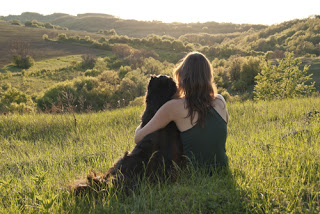
Woman cuddling dog, sitting on mountain top staring into the distance
We wish it were Friday already. We wish it were summer still. We wish it were 5pm. We wish it were holidays. We wish it were lunchtime. We wish it were Friday again. We wish we were in Fiji. We wish we were in a house of our own. We wish we were older. We wish we were young again. We wish we were married. We wish we were single. We wish our kids were at school. We wish our kids were babies again. We wish it were Friday again.
We always wish we were in some place, or some moment, other than where we are.
Why do we do that? 

In wishing we were elsewhere, we’re saying to the Universe that what we have is not good enough. But actually, what we have and what we are right now is EVERYTHING. 
It's OK to want more and strive for more - and you absolutely should - but the challenge is to not get so heavily invested in where you want to go that you forget to celebrate  today.
I love this quote from Buddha: "There are only two days of the year that nothing can be done. One is called yesterday and the other is called tomorrow. So today is the right day to love, believe, do and mostly live." 
The struggle to be fully present in the moment, and really making the most of what I have, is a constant theme in my life. I have a very busy mind that’s often consumed with worrying about the future or replaying the past. Neither of these is conducive to being right here, right now. The result is that I am often so immersed in the coming attractions that I miss the full experience of the feature. 
Image by @stealtimeback via Instagram
When I was travelling recently, I realised how much calmer I felt, because I was completely immersed in what was right in front of my eyes. This ability to tune out of the pointless (and often damaging) chatter in my mind and into everything around me is something I want to strengthen in my everyday life. When I stop to appreciate the awesomnity* of my life, it’s like putting a pin in the balloon of my worries, and simultaneously lighting a rocket under my life-satisfaction levels. That’s because I am acutely aware that I have everything I need right now, and that every element of my life is perfectly imperfect. This moment is enough. 
Recently I saw a very moving TED talk by poet Robin Morgan and it really highlighted the beautiful experience of being fully present. Robin, who has Parkinson’s disease, has written some incredibly powerful poems about the process of watching her body slow down. One of the pieces that touched me most is called This Dark Hour. I hope you enjoy it as much as I did.

***
This Dark Hour
Late summer, 4 A.M. The rain slows to a stop, dripping still from the broad leaves of blue hostas unseen in the garden’s dark. Barefoot, careful on the slick slate slabs, I need no light, I know the way, stoop by the mint bed, scoop a fistful of moist earth, then grope for a chair, spread a shawl, and sit, breathing in the wet green August air.
This is the small, still hour before the newspaper lands in the vestibule like a grenade, the phone shrills, the computer screen blinks and glares awake.
There is this hour: poem in my head, soil in my hand: unnamable fullness. This hour, when blood of my blood bone of bone, child grown to manhood now – stranger, intimate, not distant but apart – lies safe, off dreaming melodies while love sleeps, safe, in his arms.
To have come to this place, lived to this moment: immeasurable lightness. The density of black starts to blur umber. Tentative, a cardinal’s coloratura, then the mourning dove’s elegy. Sable glimmers toward grey; objects emerge, trailing shadows; night ages toward day. The city stirs.
There will be other dawns, nights, gaudy noons. Likely, I’ll lose my way. There will be stumbling, falling, cursing the dark. Whatever comes, there was this hour when nothing mattered, all was unbearably dear.
And when I’m done with daylights, should those who loved me grieve too long a while, let them remember that I had this hour – this dark, perfect hour – and smile.

***

*This is a real word. Don’t you dare google it.


How do you get back up when life kicks you down? Start with your words

Angel hugging own knees looking despondentIt’s hard to pick just one standout quote from Paulo Coelho’s The Alchemist, an exquisite book I have come back to again and again throughout my adult life, but this one would certainly be among my favourites: “The secret to life is to fall down seven times and get up eight times.”
In less poetic terms: “I get knocked down, but I get up again.” (Thanks for that, Chumbawamba.*)
Picking yourself up again after failure, humiliation and heartbreak is achingly difficult, but very necessary if you want to move forward in your life. What Paulo Coelho is describing so lyrically is resilience.
So that’s the ‘why’; this is the ‘how’. The words you use are extremely powerful when it comes to getting back up when you are down. I know this because science.

There’s a well-known study in which Japanese researcher Dr Masaru Emoto took two identical jars of cooked rice and wrote “thank you” on one, and on the other “you fool”. He had school children say the labels out loud to the jars every day as they walked past. After 30 days the jar that had received positive affirmation was healthy while the one that was abused had become mouldy and rotten. The conclusion: words have the power to affect us on a cellular level, so it’s important to choose positive ones. In the interests of balance, I should probably point out here that the scientific community have been fairly critical of Dr Emoto’s research techniques. Still, the finding is an intriguing one.
Improving my self-esteem has been a real focus for me this year, but what I’m realising lately is that it’s actually self-compassion which is more beneficial to my confidence levels and life successes than self-esteem. And just like Dr Emoto I’m fascinated by the power of words – specifically, how the language I use in speaking to myself (both internally and externally) could play a key role in making me a better me.  
The difference between self-esteem and self-compassion, explains respected US self-compassion researcher Dr Kristin Neff, is that the former often involves us comparing ourselves to other people. Which no one does, obviously… except me and, you know, every woman ever. (And potentially a lot of men too.)
Woman kissing out love hearts
Comparison might briefly boost your self-esteem if you conclude that you’re better than other people in some way... but when you feel like everyone else is doing life better than you, your self-esteem is going to suffer – badly. (Guilty as charged.) Self-compassion, on the other hand, doesn’t hinge on you feeling special or different – all it depends on is you treating yourself like a human being who deserves love and care.
Here’s what happens: when you criticise yourself, cortisol (the stress hormone) is released in your body. The resulting stress lowers your mood and motivation. So basically, criticism is being absorbed by your cells**. Yikes! But if, instead of criticising yourself, you can pick yourself up in times of darkness and reassure yourself that the failure you’ve suffered doesn’t diminish your value as a human being, you’ll be better able to get back up and try again, says Dr Neff.

In other (my own), words, kicking your own arse only works if you do it with kindness.
Perhaps this could go some way to explaining why so many women struggle to lose weight in the long term. If you slip up with your exercise and diet plan, then start beating yourself up and call yourself fat, you’re unlikely to get back on track with your weight-loss journey the next day.
I don’t know what you guys take from these findings, but for me, it’s made being nice to myself a far greater priority. It’s looking very much to me like being my own best friend is the secret to getting back up again when life kicks me down. This is a friendship worth making time for.


*Here’s a Chumbawamba throwback, because I know you want it. (Lets just overlook the fact that the song’s about drinking, ’kay?)

**Did you know we have more than 50 billion cells in our body? Whoa! I learned this at a recent seminar by wellness guru Dr Libby Weaver. 

What moving to a new house taught me about letting go

Woman's face among moving boxesThere’s nothing quite like moving house to make you realise you own far, far more possessions than you actually need. I shifted to a new address last week (a revolting process, always) and I was shocked, as I always am, by how much stuff I own… and feel attached to, for reasons I can’t really explain. There were items that are currently useful, items that may be useful in the future and items that are not useful at all but are lovely. As I gathered up and disposed of the items that didn’t fall into any of these categories, I wondered how I can dispose of all the other clutter that’s taking up space in my life – the emotional baggage.

About 10 years ago I went to a Christmas Eve mass in Bondi, which is a suburb of Sydney with a high percentage of travellers, particularly from the UK and Ireland. In his sermon the priest talked about how many backpackers he sees around the neighbourhood carrying their life’s possessions on their shoulders, and he likened this to the emotional baggage so many of us carry around that weighs us down. This is the only sermon I’ve ever heard that I have never forgotten – and since I was forced to attend church services for the first 16 years of my life, I’ve heard a LOT of sermons. He talked about how if we have faith in something, we have everything we need. There’s no cause for carrying around worries. This is the beautiful and alluring promise of spirituality, in all forms: peace. No matter who or what you believe in, if it brings you peace, hold on to it.
When the priest described the burden of emotional baggage in such simple terms, releasing it sounded simple too. But if you’ve read even one post on this blog, you’ll know that my belief in angels and the Universe and goodness and love and human kindness have not shielded me from moments of worry, fear or despair. That’s because I am human. (Just on that note, I would recommend you steer clear of any spiritual guru or blogger who claims they have eliminated these emotions from their lives, and promises that you can too. Utter delusion.) And like every other human I know, I have baggage. And yes, its weighing me down. 
Here’s a popular saying that pops up on Instagram from time to time: Life is a delicate balance of holding on and letting go. Like, I suspect, most people, I have a tendency to quit at times when I need to hold on, and to stubbornly clutch onto the destructive old stories and the limiting beliefs that I need to release. As previously mentioned, I am human.
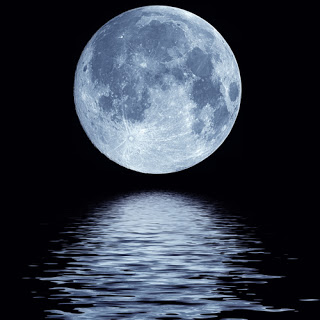
Full moon rising over the water
There’s a lot I need to let go of right now. And as it’s the super moon, and there’s an eclipse, and a blood moon, and a bunch of other (apparently) VERY SIGNIFICANT astrological portents I don’t really understand, it seemed like a good time to do a quick stocktake of my emotional baggage. It wasn’t a long list, but some of the items were fairly weighty – and many were coated in layers of dust. These include, but are not limited to, my regret over my mediocre career and my ongoing guilt at living far away from my family. None of what I listed is serving any purpose, except making me feel crappy, which isn’t all that useful. Some of this stuff is old and I’m ready to ditch it; some of it needs further processing first. But what if I could just gently ease my backpack straps off my shoulders, place the burden on the floor and walk away? What would that feel like? What would it be like to be so light?
I don’t think I can ever clear away ALL of the suitcases or ditch my backpack but I think that by having awareness of the areas where I’m weighed down, I can start to unpack them gradually. For example, when I notice I’m beating myself up about my lack of professional success (yet again), I feel better equipped to talk myself out of that negative spiral before it snowballs into full-scale self-sabotage.
I do think that sometimes we can continue unhelpful thought patterns even though we’ve long since outgrown them – because they’re comforting in some way. A bit like how I kept drinking beer for years after I had adopted a gluten-free diet – even though beer is loaded with gluten. I kept drinking it because the habit was familiar. Earlier this year I swapped out beer for red wine and the difference to my stomach has been remarkable... as I had known it would be. So why hadnt I stopped years before? Sometimes thoughts and habits that are unhelpful, or downright destructive, are comforting because theyre familiar. Its not until you make a point of clearing them away that you remember what its like to feel freer, lighter, better.
What about you. Is there something old and heavy that youre ready to clear away? 

Deluded much? Maybe it's the third eye chakra

Woman with hands over eyes, letters of the alphabet coming out of her head

Ever seen a hopelessly untalented contestant audition for The X Factor and wondered, ‘how can they possibly think they can sing?!’ That’s delusion – and it’s something we all suffer with at various points in our lives. Sometimes delusion can be caused by a block in the third eye chakra, which is the energy centre all about perception and intuition.

The ‘third eye’ is a term commonly used to refer to psychic ability, which is something we all possess to various levels. In almost every angel card reading I do, a message will come through about trusting your intuition. That’s because we all have a direct line to the Universe, and through that we’re given all the information and answers we could possibly need. But our brain just loves to interfere with these messages and tell us that we’re being ridiculous or we’re imagining things. Ensuring your third eye chakra is balanced is one way you can make sure you receive those messages clearly.

Imagination is associated with the third eye chakra, so people in creative industries in particular will benefit strongly from keeping this chakra in balance.

Memory is also highlighted in this chakra, so people who have buried, or are tortured by, unpleasant memories may experience third eye chakra blocks.

While the heart chakra’s enemy was grief and the throat chakra’s adversary was lies, the third eye chakra’s challenge is illusion, or a false sense of belief. If the third eye chakra is in balance we’re able to perceive things as they really are. We’re able to use our intuition to make good choices. We remember our dreams and instinctively understand their significance. We’re able to use visualisation to manifest what we want. We’re also able to detect what isn’t being said by people – in other words, an ability to read people’s body language and elicit meaning from the tone of their voice. We recognise the beauty in our jobs, our relationships and our bodies instead of wishing they were something else.

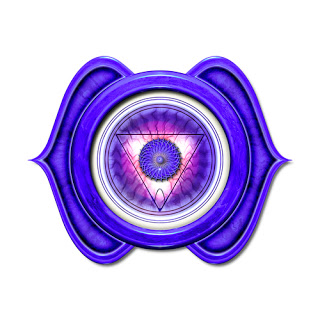
The third eye chakra symbol

(Image: the third eye chakra symbol)

When the third eye chakra is deficient, you might display these traits:

* Poor memory

* Lack of imagination

* Denial of present circumstances

* Excessive scepticism

When the third eye chakra is excessive, you might experience:

* Delusions of grandeur

* Obsessions and fantasising

* Difficulty concentrating

* Illusions

* Nightmares

To bring the third eye chakra into balance, meditation and rest are essential. You could also try keeping a dream journal beside your bed, and writing down key themes from intense dreams when you wake up; this helps you notice patterns and messages from your intuition. For yoga types – resting child’s pose and fish pose are helpful.

****

Read my posts about the other chakras here:

Base chakra

Sacral chakra

Solar plexus chakra

Heart chakra

Throat chakra

If you’d like to work with me to heal any of the issues in this article, you can book energy healing sessions here. More information about how I work is available here.  

Things I learned about myself while travelling

Woman reading map

I’ve recently returned from a holiday overseas, which was absolutely everything I needed it to be. Not only did the trip do the world of good for my health and wellbeing, but it also gave me plenty of opportunities for self-reflection. Here is some of what came to light.

I am better at dealing with unfamiliar situations than I used to be. I remember five years ago when I was visiting Vancouver, I got hopelessly lost and became so worked up about it that I couldn’t decipher my map. Embarrassingly, I started crying. I did become lost several ttimes on this trip (it’s inevitable) and although it was frustrating I noticed it no longer sends me into panic mode. Which meant I was therefore more open to the opportunities it would open up. And that’s because…
Woman with suitcase on railway tracks
Being in another country forces you to relinquish control. If you’ve ever been to Venice, a labyrinthine city in which maps are useless, you’ll have experienced that liberation of deciding to simply go with the flow. This happens to me almost every time I travel, regardless of language or navigational difficulties. When you can’t find that Yelp-recommended restaurant and you’re so hungry you could chew your arm off, you have to go with the eatery that is right in front of you. And even though the place is empty (which might be a bad sign) and you don’t speak Korean (and Google Translate won’t work without WiFi), you have to take a punt and hope what you're eating is edible and gluten-free. It will be fine, it always is.
I am better at talking to strangers than I used to be. I will never be entirely comfortable at meeting new people, but I have noticed that over the past year I am less likely to freeze and stammer awkwardly than I used to be. This sounds like a minor thing but what it shows me is that I am more comfortable within myself than ever before.
Nice people are everywhere. They really are. Without me asking (I have never been good at asking for help), people will detect that you need assistance. I had people grab hold of one end of my suitcase when I was struggling with it on the subway stairs. People approach me and offer guidance when I was trying to work out which side of the avenue I needed to be on. People walk up to me and start chatting when they saw me drinking alone. And that was in New York – which I’d been led to believe was full of hard, aggressive people.
More than being in a new location, it’s being out of your normal routine that benefits you the most. In the absence of concerns about work, relationship conflicts, household chores and general life admin, it’s easier to be fully present in the moment. You soak in sights, smells and energies that you don’t notice in your everyday world. You’re transported back to a child-like state of wonder and life feels like an adventure again. Every day I was away felt like it lasted at least two days, and it was glorious. Of course it’s not possible for this to shape every day of your life, but I’d like to find ways to bring back more wonder into my daily life and be more cognisant of the beauty that makes up my world.
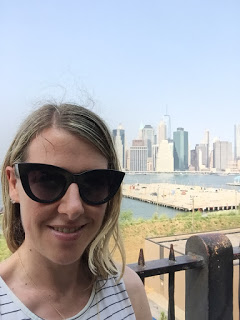
Me, Brooklyn Heights,  Manhattan behind me.
It also created space for a lot negative self-talk that’s been going on in the background to come to the fore, which has affirmed some areas I need to work on.

I am essentially a good person. I noticed that whenever customer service clerks were rude to me, which was often, I would always endeavour to counter that with an overdose of politeness. I’d be lying if I said this wasn’t partially to draw attention to their rudeness. But mostly it was because I could tell they really needed someone to be nice to them. I’m being overly simplistic here because I don’t think there’s a need to dress this up: if you can spend time among rude people and not become rude yourself, you’re probably a good person.

Other people might take your holiday personally. I don’t mean that literally, as in, other people will come along for the ride, but I have found that many people processed my holiday stories and photos in relation to their own lives, even though my trip had nothing to do with anyone else. When I posted holiday photos (and I did limit them to two or three pictures a day), some people would rush in and comment how they’d already been there and seen that, as if this made them somehow superior. Some would openly say: ‘I’m so jealous!’ Which I find baffling. (If you want a holiday, why don’t you just book one? Its not like I have something you cant have.) And then when I returned, some people apparently thought I needed to be brought down a peg or two, so without me even speaking they would make smirking comments like: ‘I bet you feel like you never even left!’ and ‘you're not on holiday now!’ I’m not sure why some people are resistant to other people having a good time. People are weird.